






















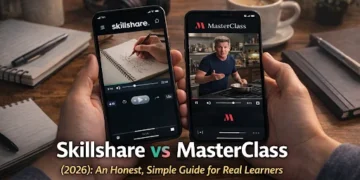

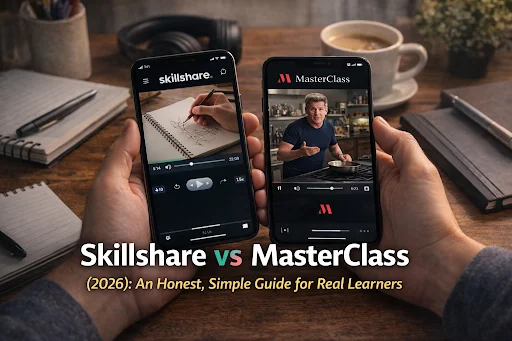
If you search for “Skillshare vs MasterClass,” you’ll get hundreds of articles saying the same thing in different words. Several feel unnatural, overly optimized, and written for Google instead of humans.
Let’s do this the right way.
I’ve used both Skillshare and MasterClass at different points of my learning journey. I didn’t test them for one week just to write a review. I paid for them, ignored them for months, came back frustrated, figured out what worked, and eventually learned what each platform is actually good at.
According to Forbes, the online learning market has grown 900% since 2000, with platforms like Skillshare and MasterClass leading the creator-taught education revolution. But that doesn’t tell you which one deserves your money and time.
This article is meant for real learners, not hype. Plain terms. Transparent thinking. Bullets used wisely.
The Bottom Line (If You’re in a Hurry)
If you want practical skills you can use immediately, Skillshare is better.
If you want inspiration, creative thinking, and world-class expert lessons, MasterClass is better.
That’s the honest answer.
Let’s dig into why, and more importantly, which one fits YOUR specific situation.
What Skillshare Really Is (Not the Marketing Version)
Skillshare is designed for people who want to learn by doing. It feels like entering a space where working professionals share what actually works for them—not academic theory, but real-world application.
Most Skillshare instructors aren’t celebrities. They’re copywriters, content creators, designers, freelancers, and marketers whose careers transformed because they mastered specific tools and techniques. The teaching style reflects this: practical, down-to-earth, and action-oriented.
What Makes Skillshare Different
Classes are intentionally short. You don’t sacrifice your entire weekend to complete a course. Most lessons run 5-15 minutes, making it easier to maintain focus and fit learning into busy schedules.
Project-based learning is fundamental. Research from Harvard Business Review shows that project-based learning increases skill retention by 75% compared to passive video watching. Skillshare embraces this: nearly every class includes a small project—a design, piece of writing, social media plan, or portfolio piece. This transforms theory into tangible skills.
The community aspect matters. You can upload your projects, see what others create, and sometimes receive feedback. This simple interaction keeps many learners motivated and accountable.
Instructor accessibility varies but exists. Some instructors actively engage in Q&A, while others are less responsive. The platform doesn’t guarantee instructor interaction, but the possibility exists—something MasterClass doesn’t offer at all.
Skillshare’s Practical Applications
Many students use Notion for project management to track which Skillshare courses they’ve completed, store project files, and maintain a portfolio of work created through classes. This organizational approach transforms casual learning into systematic skill development.
The hands-on approach extends to technical skills, too. While Skillshare offers coding courses for beginners, many learners supplement their education with AI-powered learning tools. If you’re interested in learning programming, comparing AI coding assistants like ChatGPT vs Claude can accelerate your progress—these tools work excellently alongside Skillshare’s project-based Python courses, providing instant debugging help and code explanations.
What MasterClass Really Is (Beyond the Cinematic Trailers)
 MasterClass offers a substantially different experience that’s unlike any other learning platform you’ve encountered.
Think of it as watching premium documentaries where highly accomplished people explain how they think, work, and achieve mastery. The instructors aren’t just successful—they’re recognized globally as the best in their fields.
What Makes MasterClass Unique
The production quality is extraordinary. Cinematic lighting, multiple camera angles, professional scripts, and 4K video quality. As noted in The New York Times, MasterClass has redefined celebrity education, making world-class expertise accessible to millions through production values that rival premium streaming services.
Celebrity instructors bring credibility and inspiration. When Martin Scorsese teaches filmmaking, or Serena Williams discusses championship mindset, or Chris Voss (former FBI hostage negotiator) explains negotiation psychology—you’re learning from people who’ve operated at the absolute peak of their professions for decades.
MasterClass focuses on transforming perspective rather than teaching specific tactical skills. You won’t learn how to use software or get step-by-step instructions for most tasks. Instead, you’ll understand how masters think about their craft, handle creative challenges, and maintain excellence over time.
The experience is designed for immersion. Classes typically run 2-5 hours total, divided into 10-25 lessons. Each lesson feels like a TED Talk meets behind-the-scenes documentary. The pacing encourages deep reflection rather than rapid skill acquisition.
The MasterClass Philosophy
According to cognitive science research published in NIH, learning retention increases significantly when students immediately apply concepts through projects. MasterClass takes a different approach: it prioritizes mental models, creative philosophy, and strategic thinking over immediate application.
This isn’t better or worse—it’s fundamentally different. MasterClass assumes you’ll take the inspiration and wisdom, then figure out the application in your own context.
Comprehensive Feature Comparison
Let me break down the practical differences in a way that actually helps you decide:
| Feature | Skillshare | MasterClass | Winner |
| Pricing (2026) | $168/year (often $99 with discounts) | $120–$180/year | Skillshare (with discounts) |
| Monthly Option | Yes (~$32/month) | No (annual only) | Skillshare |
| Free Trial | 1 month (frequent promos) | 30-day money-back guarantee | MasterClass (risk-free) |
| Number of Courses | 35,000+ | ~200 | Skillshare |
| Average Course Length | 20min–2hrs (avg 45min) | 2–5 hours per class | Skillshare (flexibility) |
| Individual Lesson Length | 5-20 minutes | 10-15 minutes | Tie (both mobile-friendly) |
| Video Quality | HD (720p-1080p) | Cinematic 4K | MasterClass |
| Mobile App Quality | Excellent | Excellent | Tie |
| Offline Downloads | Yes | Yes | Tie |
| Community Features | Project galleries, peer feedback | None | Skillshare |
| Instructor Q&A | Sometimes (varies by instructor) | No | Skillshare |
| Certificates | No | No | Tie (neither offers) |
| Workbooks/PDFs | Yes (most classes) | Yes (comprehensive) | Tie |
| New Content Frequency | Daily additions | Monthly (1-2 new classes) | Skillshare |
| Course Categories | 13+ broad categories | 11 focused categories | Depends on interests |
| Subtitles/Captions | Most courses | All courses (multiple languages) | MasterClass |
| Simultaneous Devices | Unlimited | 6 devices | Skillshare |
| Casting to TV | Yes | Yes (optimized for TV) | MasterClass (better experience) |
| Speed Control | Yes | Yes | Tie |
| Search Functionality | Good (can be overwhelming) | Excellent (smaller catalog) | MasterClass |
| Course Completion Tracking | Yes | Yes | Tie |
| Best For | Practical skills, portfolio building, and career transition | Creative inspiration, strategic thinking, mindset shifts | Depends on goals |
Value Winner for Most People: Skillshare (more content, lower cost, immediate application)
Premium Winner for Specific Needs: MasterClass (unmatched instructor quality, superior production, deeper inspiration)
Pricing Reality (Updated for 2026)
Let’s talk about what you’ll actually pay, not what the marketing pages say.
Skillshare Pricing Strategy
Official pricing: $168/year or $32/month
Real-world pricing: Skillshare runs promotions constantly. You can routinely find:
- First-year discounts bringing annual cost to $99
- 1-month free trials (no credit card required during promotions)
- 2-month free trials for students with .edu email addresses
- Seasonal sales (Black Friday, New Year) offering 40-50% off
Pro tip: Never pay full price for Skillshare. If you don’t see a discount, open an incognito browser window or wait 2-3 weeks. A promotion will appear.
Cancellation: Easy to cancel anytime. No long-term commitment required with monthly plans.
Pricing verified from Skillshare’s official pricing page as of January 2026.
MasterClass Pricing Strategy
Official pricing: $120–$180/year, depending on plan selected
Payment structure: Annual payment only—no monthly option available
What this means: You commit to a full year upfront. This makes MasterClass more expensive psychologically, even if the absolute dollar amount is similar to Skillshare.
Refund policy: 30-day money-back guarantee. If you’re not satisfied within the first month, request a full refund. This is genuinely honored based on user reports.
Gift option: MasterClass positions itself as a gift-worthy platform. Gift subscriptions are available, which speaks to its premium positioning.
Family sharing: While not officially supported, MasterClass allows 6 simultaneous devices, which many families use as de facto sharing (though this technically violates terms of service).
Pricing verified from MasterClass’s official plans page as of January 2026.
Which Represents Better Value?
For explorers and beginners: Skillshare provides dramatically more value. 35,000+ courses for ~$99/year means you’re paying less than $0.003 per course available.
For focused learners seeking inspiration: MasterClass’s $120-180/year for 200 world-class expert courses means ~$0.60-0.90 per course, but the quality per course far exceeds Skillshare’s average.
My personal approach: I maintain both subscriptions because they serve different purposes in my learning ecosystem. Total annual investment: ~$220. This is less than one community college course and provides exponentially more flexibility.
Standout Courses Worth Your Time
 After two years with both platforms, these courses consistently deliver value:
Best Skillshare Courses (Based on Real Experience)
Design & Creativity:
- Logo Design Fundamentals by Aaron Draplin – No-nonsense design principles from a working professional. Practical, funny, immediately applicable.
- Procreate for Beginners by Lettie Blue – The definitive starting point for digital art on iPad. Clear, comprehensive, project-based.
- Typography Fundamentals by Ellen Lupton – Teaches you to see type design like a professional. Transformed how I evaluate visual design.
- Canva for Beginners by multiple instructors – Quick graphic design without Adobe’s complexity
Many Skillshare design students start with Canva because it’s free and beginner-friendly. If you’re specifically interested in creating presentations, social media graphics, or marketing materials, our detailed guide on creating presentations in Canva complements Skillshare’s design fundamentals courses perfectly—learn design principles on Skillshare, apply them immediately in Canva.
Business & Marketing:
- Instagram Marketing Strategy by Jera Foster-Fell – Real tactics that work today, not outdated growth hacks
- SEO for Beginners by Brian Dean – Practical SEO without overwhelming technical jargon
- Copywriting for Social Media by Alex Cattoni – Immediately applicable writing frameworks that improve engagement
- Freelance Pricing Workshop by multiple instructors – How to actually charge what you’re worth
Creative Writing:
- Creative Writing: Crafting Personal Essays by Roxane Gay – Thoughtful approach to storytelling and voice development
- Writing with Flair: How to Become a More Productive Writer – Various instructors offer different approaches worth exploring
Productivity & Tools:
- Productivity Masterclass by Thomas Frank – Systems that actually stick beyond the initial motivation
- Notion Fundamentals – Several excellent options for mastering this increasingly essential tool
Why these work: All under 2 hours, project-based, designed for immediate application. You finish with something tangible, not just knowledge.
Best MasterClass Courses (Based on Real Impact)
Creative Arts:
- Photography by Annie Leibovitz – Less about camera settings, more about creative vision and emotional storytelling through images
- Filmmaking by Martin Scorsese – Masterful breakdown of cinematic storytelling, shot composition, and directing actors
- Directing by Ron Howard – Behind-the-scenes look at creative decision-making on major productions
- Writing by Margaret Atwood – Literary thinking, developing voice, and the creative process from a master novelist
Performance & Communication:
- Acting by Natalie Portman – Character development and performance psychology applicable beyond acting
- Comedy by Steve Martin – Timing, structure, and creative thinking that applies to any performance or presentation
- Communication by Robin Roberts – Authentic presence, connection, and vulnerability in professional settings
Business & Leadership:
- Negotiation by Chris Voss (former FBI hostage negotiator) – Counterintuitive tactics that work in business and life. One of MasterClass’s most practically applicable courses.
- Business Strategy by Bob Iger (former Disney CEO) – Leadership at the highest corporate level, navigating complex organizations
- Disruptive Entrepreneurship by Sara Blakely (Spanx founder) – Building a billion-dollar brand from scratch
Sports & Competition (Mental Game Lessons):
- Tennis by Serena Williams – Championship mindset and competitive psychology that transcends sports
- Chess by Garry Kasparov – Strategic thinking, pattern recognition, and decision-making under pressure
Culinary (Surprisingly Educational):
- Cooking by Gordon Ramsay – Multiple classes covering technique, restaurant management, and culinary philosophy
- Cooking Fundamentals by Thomas Keller – Precision, technique, and the philosophy of excellence in craft
Why these work: You’re not just learning what these masters do—you’re understanding how they think. The mental models and perspectives often prove more valuable than specific techniques.
Mobile App Experience: Real-World Usage Comparison
I’ve used both apps extensively on iOS and Android devices during commutes, lunch breaks, and travel. Here’s what actually matters:
Skillshare Mobile App: Practical Learning On-the-Go
Strengths:
- Clean, intuitive interface – Finding classes and resuming where you left off is effortless
- Excellent video playback – Reliable streaming with minimal buffering
- Offline downloads – Essential for commutes, flights, or areas with poor connectivity
- Easy project uploads – Can upload finished projects directly from your phone camera
- Search works well – Though the vast catalog can feel overwhelming on smaller screens
- Picture-in-picture mode (iOS) – Continue watching while checking other apps
Weaknesses:
- Occasional buffering on slower 3G connections
- Class browsing can feel overwhelming with 35,000+ options
- Community features work better on desktop (larger screen helps)
- No ability to filter as precisely on mobile as on desktop
Best Use Cases:
- Learning during daily commute (subway, bus, train)
- Lunch break skill-building (15-30 minute sessions)
- Waiting rooms, airports, downtime
- Quick reference when working on projects
My Real Experience: I completed entire Skillshare courses during my 40-minute daily train commute. The short lesson format (5-15 minutes) perfectly matches fragmented mobile learning time. Downloaded classes the night before, watched offline during commute, uploaded projects when back on WiFi.
MasterClass Mobile App: Premium Learning Experience
Strengths:
- Gorgeous interface design – Feels like a premium streaming app (Netflix-quality)
- Flawless video streaming – High production quality shows clearly even on phones
- Exceptional audio quality – Can listen to podcasts during walks or chores
- Complete offline downloads – Download entire classes for offline viewing
- Position memory is perfect – Always resumes exactly where you left off, even across devices
- Comprehensive subtitles – Available in multiple languages, great for accessibility
Weaknesses:
- Requires stronger internet for high-quality streams (4K is data-intensive)
- Large file sizes for downloads (200-500MB per lesson in HD)
- Better suited for tablets than phones (small screen doesn’t do justice to cinematography)
- Less suitable for quick “snackable” learning compared to Skillshare
Best Use Cases:
- Deep weekend learning sessions
- Evening wind-down (inspirational rather than practical)
- Long flights (download multiple classes)
- Casting to TV for a full cinematic experience
- Audio-only listening during commutes (podcast-style)
My Real Experience: MasterClass feels more like watching a premium documentary series than taking a course. I frequently cast it to my TV for the full cinematic experience—something I never do with Skillshare. The production quality deserves a larger screen. I also listen to MasterClass audio-only during walks, treating it like high-quality podcasts.
Mobile App Winner: Tie, But For Different Reasons
Skillshare wins for: Quick learning, commute-friendly formats, fragmented time optimization, project-based mobile work
MasterClass wins for: Immersive experience, audio-only learning, premium feel, casting to TV, download quality
Bottom line: Both apps are excellent. Your choice depends on whether you’re learning in 15-minute fragments (Skillshare) or dedicated 1-2 hour sessions (MasterClass).
Teaching Quality: Where the Philosophical Difference Becomes Clear
This is where Skillshare and MasterClass diverge most significantly.
Skillshare’s Teaching Philosophy: Learn by Doing
Skillshare feels casual, sometimes imperfect, but genuinely helpful. Course quality varies dramatically:
Top-tier Skillshare courses (maybe 20-30% of catalog):
- Clear learning objectives
- Step-by-step instructions
- Downloadable resources
- Engaged instructors who answer questions
- Projects that reinforce concepts
Mid-tier courses (about 50% of the catalog):
- Solid information, but less polished
- Adequate instruction without excellence
- Projects exist, but may not be as engaging
- Less instructor engagement
Lower-tier courses (remaining 20-30%):
- Outdated information
- Unclear teaching
- Minimal production quality
- Abandoned by instructors (no Q&A responses)
The key: You must curate carefully. Look for:
- High student counts (1,000+ students suggests quality.)
- Recent upload dates (within 2 years)
- Instructor response rate in the Q&A section
- Detailed course descriptions with clear outcomes
The benefit: When you find excellent Skillshare instructors, they show you exactly what you need to start. The best classes provide templates, resources, and frameworks you can implement immediately.
MasterClass’s Teaching Philosophy: Learn by Understanding Masters
MasterClass instructors are polished, thoughtful, and operate at the highest level of their fields. Every class undergoes extensive production planning.
What to expect:
- Instructors share decades of experience compressed into hours
- Stories of failures, breakthroughs, and lessons learned
- Behind-the-scenes insights into their creative process
- Philosophical approaches to their craft
- Historical context and evolution of their thinking
What NOT to expect:
- Step-by-step tactical instructions for most topics
- Software tutorials or technical how-tos
- Immediate “do this tomorrow” action items (usually)
- Beginner-level explanations of fundamentals
The trade-off: You may not receive clear step-by-step guidance, but you’ll gain profound insight into how mastery actually works. There’s no “wrong” approach here—they simply satisfy different learning needs.
According to LinkedIn Learning’s 2024 Workplace Learning Report, 94% of employees would stay at a company longer if it invested in their learning, highlighting how platforms like Skillshare and MasterClass contribute to both personal and professional development.
Real-World Examples: Photography Learning
Let me make this concrete with a specific skill:
Learning Photography on MasterClass
Annie Leibovitz teaches photography on MasterClass.
What you’ll learn:
- How she conceptualizes photo shoots
- Working with natural light vs studio lighting (philosophy, not settings)
- Developing a photographic point of view
- Telling stories through portraiture
- Her creative process from concept to final image
- Handling celebrity subjects and difficult shoots
What you WON’T learn:
- Specific camera settings for different scenarios
- How to use Lightroom or Photoshop
- Technical aspects of the exposure triangle
- Equipment recommendations for beginners
- How to find photography clients
Outcome: You’ll understand photography as an art form. You’ll think about emotion, narrative, and creative intent. You’ll feel inspired to pick up your camera with renewed purpose.
Best for: Intermediate photographers feeling creatively stuck, anyone interested in photographic storytelling.
Learning Photography on Skillshare
Multiple beginner photography courses available.
What you’ll learn:
- Detailed camera settings (aperture, shutter speed, ISO)
- How to shoot in manual mode
- Composition rules and when to break them
- Editing photos in Lightroom (step-by-step)
- Creating a photography portfolio
- Finding your first photography clients
Class structure:
- Project 1: Shoot in manual mode
- Project 2: Edit 5 photos
- Project 3: Create a portfolio website
- Project 4: Reach out to potential clients
Outcome: You’ll have technical skills, finished projects, and potentially your first paying client within weeks.
Best for: Complete beginners who want to start taking better photos immediately, aspiring professional photographers building skills.
Which Approach Works Better?
If your goal is: “I want to take better photos for Instagram starting this week.”
Choose: Skillshare
If your goal is: “I want to understand photography as a creative medium.”
Choose: MasterClass
The ideal approach: Start with Skillshare to build technical skills, then watch MasterClass to elevate your creative thinking once you’re comfortable with fundamentals.
Which Platform Is Better for Different Goals?
 Let me be specific about who should choose which platform:
Choose Skillshare If You:
✅ Are a complete beginner needing structured, step-by-step guidance
✅ Want practical skills you can apply immediately at work or in projects
✅ Are career-switchers and need to test skills without a massive investment
✅ Learn best by doing rather than watching and reflecting
✅ Have limited time and need 15-30 minute learning sessions
✅ Want to build a portfolio of work to show employers or clients
✅ Need variety and want to explore many different skills cheaply
✅ Prefer community feedback on your work
✅ Value quantity of learning options over celebrity instruction
Example learner: Marketing professional wanting to add design skills, stay-at-home parent exploring freelance opportunities, recent graduate building employable skills.
Choose MasterClass If You:
✅ Are you an experienced professional feeling stuck or uninspired
✅ Seek creative inspiration more than tactical instruction
✅ Want to understand how masters think, not just what they do
✅ Appreciate premium production and cinematic learning experiences
✅ Learn through reflection and deep thinking about concepts
✅ Have dedicated learning time for 1-2 hour focused sessions
✅ Value depth over breadth in course selection
✅ Are interested in celebrity perspectives and industry stories
✅ Need mental models and strategic thinking frameworks
Example learner: Senior professional preparing for leadership roles, creative experiencing burnout, entrepreneur seeking strategic insights, and anyone fascinated by excellence and mastery.
The Hybrid Approach (My Recommendation)
Many successful learners use both platforms strategically:
Skillshare for: Monday-Friday practical skill-building (30 min daily)
MasterClass for: Weekend deep dives and inspiration (2-3 hours)
Skillshare for: Hard skills (design, writing, coding, marketing)
MasterClass for: Soft skills (leadership, negotiation, strategic thinking)
Skillshare for: Building your portfolio and getting clients
MasterClass for: Elevating your thinking and staying inspired long-term
Total investment: ~$220-260/year for both platforms
Value comparison: Less than one community college course, university textbook costs for one semester, or 3-4 hardcover business books
Real-World Success Stories: Who Benefited and How
Let me share actual scenarios where one platform clearly outperformed the other:
Scenario 1: Career Transition Into Tech (Skillshare Winner)
Marcus’s Situation: 32-year-old retail manager wanting to transition into UI/UX design with zero technical background.
Platform Choice: Skillshare
Learning Path:
- “UI/UX Design Fundamentals” by multiple instructors (3 courses, 6 weeks)
- “Figma for Beginners” (2 weeks practicing daily)
- “Portfolio for UX Designers” (4 weeks building projects)
- Completed 10+ small design projects posted to the Skillshare community
Result:
- Built a portfolio strong enough to land a junior UX role within 6 months
- Total investment: $99 (Skillshare annual with discount)
- Landed $55k/year starting salary (vs $32k retail)
Why Skillshare won: Marcus needed practical, immediately applicable skills with portfolio pieces to show employers. MasterClass wouldn’t have taught software proficiency or provided project-based practice.
Key takeaway: For career changers needing demonstrable skills, Skillshare’s project-based approach is unmatched.
Scenario 2: Creative Burnout Recovery (MasterClass Winner)
James’s Situation: Professional photographer for 8 years, technically skilled but creatively exhausted and questioning his career.
Platform Choice: MasterClass
Learning Path:
- Annie Leibovitz’s Photography class (deep dive over 3 weeks)
- Martin Scorsese’s Filmmaking class (expanded creative thinking)
- Ken Burns’s Documentary Filmmaking (storytelling approaches)
- Returned to photography with a renewed perspective
Result:
- Didn’t learn new technical skills (already expert-level)
- Reconnected with why he became a photographer
- Started personal art project (not client work)
- Reignited passion sustained career for 2+ more years
- Eventually transitioned into photojournalism (more fulfilling)
Why MasterClass won: James didn’t need more technical knowledge. He needed inspiration, perspective, and connection to mastery. Skillshare’s tactical courses wouldn’t have addressed his deeper creative crisis.
Key takeaway: For experienced professionals facing burnout, MasterClass’s inspirational approach can be career-saving.
Scenario 3: Aspiring Freelance Writer (Hybrid Approach)
Sarah’s Situation: College graduate with an English degree, wanting to become a professional freelance writer but lacking practical business skills.
Many MasterClass students watch Margaret Atwood, Malcolm Gladwell, or David Sedaris for writing inspiration, then wonder: “How do I actually start earning money from writing?”
The truth is, becoming a freelance writer requires both the creative mindset MasterClass provides and the practical business skills Skillshare teaches.
Platform Choice: Both (strategic combination)
Learning Path:
From MasterClass:
- Margaret Atwood’s Writing class (voice, creativity, literary technique)
- Malcolm Gladwell’s Writing class (research, storytelling structure)
- Developed creative confidence and writing philosophy
From Skillshare:
- “Copywriting Fundamentals” (persuasive writing for clients)
- “SEO Writing Basics” (content that ranks and converts)
- “Freelance Business Setup” (pricing, contracts, finding clients)
- “Portfolio Building for Writers” (showcasing work effectively)
Result:
- First paying client within 8 weeks (blog writing at $150/article)
- Year one income: $28,000 part-time
- Year two income: $62,000 full-time
- Total investment: ~$220 for both platforms
Why the hybrid approach won: Sarah needed MasterClass for creative development and confidence, plus Skillshare for practical business skills and client acquisition strategies.
Key takeaway: Creative professionals often benefit from combining inspirational learning (MasterClass) with practical business skills (Skillshare).
Scenario 4: Executive Leadership Development (MasterClass Winner)
Lisa’s Situation: Senior manager at Fortune 500 company preparing for C-suite promotion, strong operational skills, but lacking strategic leadership perspective.
Platform Choice: MasterClass
Learning Path:
- Bob Iger (Disney CEO) – Business Strategy & Leadership
- Chris Voss (FBI Negotiator) – High-Stakes Negotiation
- Robin Roberts (Journalist) – Communication & Authenticity
- Doris Kearns Goodwin – Presidential Leadership Lessons
- Howard Schultz (Starbucks) – Leading with Purpose
Result:
- Gained strategic thinking frameworks
- Improved negotiation skills (applied in promotion discussions)
- Developed authentic leadership presence
- Successfully promoted to VP role
- Attributes mental shift partly to MasterClass insights
Why MasterClass won: Lisa didn’t need tactical skills—she had 15 years of operational excellence. She needed to think strategically like executives, understand leadership psychology, and develop presence. Skillshare doesn’t offer executive-level strategic thinking from world-class leaders.
Key takeaway: For senior professionals developing leadership capabilities, MasterClass’s access to legendary leaders provides unique value.
Scenario 5: Student Exploring Career Options (Skillshare Winner)
Alex’s Situation: 20-year-old college student unsure about career direction, wanting to explore multiple fields before committing.
Platform Choice: Skillshare
Why Skillshare won:
- Could sample 20+ different skills affordably ($99/year)
- Short courses = low commitment per field
- Discovered genuine interests through hands-on projects
- Built a beginner portfolio across multiple disciplines
Exploration Path: Tried design (liked), writing (loved), video editing (disliked), social media marketing (interesting), web development (loved), data visualization (neutral), photography (hobby only)
Result:
- Discovered a passion for UX design through actual project work
- Changed college major based on hands-on experience
- Graduated with relevant skills employers wanted
- Avoided wasting years in the wrong career
Why not MasterClass: Fewer courses, deeper commitment per course, less hands-on exploration. Alex needed breadth and experimentation, not depth and inspiration.
Key takeaway: Young people exploring career options benefit enormously from Skillshare’s low-commitment, high-variety approach.
Community and Interaction: The Social Learning Aspect
Skillshare Community Features
What exists:
- Project galleries where students post work
- Peer feedback on projects (when the community engages)
- Discussion threads under each class
- Instructor Q&A sections (participation varies dramatically)
- Ability to follow other students and instructors
Real-world effectiveness: The community feature is simple but genuinely useful for motivated learners. Uploading your work creates accountability. Seeing others’ projects inspires and shows what’s possible.
My experience: I posted design projects to Skillshare galleries and received helpful feedback from 3-5 other students within days. Not transformative, but enough encouragement to keep improving. Some classes have vibrant communities (hundreds of posted projects), while others feel abandoned.
Limitation: Skillshare isn’t a dedicated social network. Don’t expect deep relationships or mentorship. Think of it as helpful encouragement rather than intensive community.
Who benefits most:
- Beginners need validation that their work is progressing
- Self-motivated learners wanting gentle accountability
- People who enjoy seeing others’ creative work
- Anyone who learns well from peer examples
MasterClass: Solitary Learning Experience
What exists:
- Nothing social. Zero community features.
- No student interaction whatsoever
- No way to post work or get feedback
- No instructor interaction (they’re busy being famous)
The MasterClass philosophy: You watch world-class masters, absorb their wisdom, reflect privately, and apply insights in your own context. The experience is deliberately solitary and contemplative.
My experience: I initially missed community features, then realized MasterClass’s approach works differently. It’s like reading a profound book—you don’t need to discuss it with other readers to gain value (though you can seek discussions elsewhere).
Who does this work for:
- Self-directed learners who don’t need external validation
- Reflective thinkers who process internally
- Experienced professionals who know how to apply insights independently
- Anyone who dislikes social pressure in learning
Who doesn’t this work for:
- Beginners needing feedback and encouragement
- Social learners who thrive on interaction
- People requiring accountability from others
- Anyone wanting to connect with fellow students
Community Winner: Skillshare (But It’s Not Essential)
If community matters to you, Skillshare wins by default. However, don’t overestimate community importance—most successful learning happens through individual effort regardless of platform.
Both platforms ultimately place responsibility on YOU to apply what you learn. Community features don’t replace self-discipline and consistent practice.
Certificates and Career Value: The Honest Truth
 Let me be direct about something both platforms rarely emphasize:
Neither Platform Offers Meaningful Credentials
Skillshare: No certificates. No badges. No completion credentials recognized by employers.
MasterClass: No certificates. No professional recognition. No academic credit.
Why this matters: If you need credentials for:
- Job applications requiring specific certifications
- Career changes requiring proof of qualification
- Professional licensing or continuing education
- University credit transfer
- Employer tuition reimbursement programs
Neither platform helps you.
For career-focused credential learning, consider platforms like Coursera or Udemy instead, which offer certificate programs and even university-accredited courses that employers recognize—something neither Skillshare nor MasterClass provides. These platforms bridge the gap between casual learning and formal credentials.
What They DO Offer for Career Value
Skillshare’s career value:
- ✅ Actual skills you can demonstrate through portfolio work
- ✅ Project-based experience showing competency to employers
- ✅ Quick skill acquisition for job-specific needs
- ✅ Portfolio building through class projects
- ✅ Practical knowledge applicable on Monday morning at work
Example: You can’t put “Completed Skillshare Design Course” on your resume, but you CAN showcase the 10 design projects you created, link to your portfolio, and demonstrate skills in interviews.
MasterClass’s career value:
- ✅ Strategic thinking frameworks from world-class leaders
- ✅ Leadership perspective informing decision-making
- ✅ Creative problem-solving approaches from masters
- ✅ Mindset shifts affecting long-term career trajectory
- ✅ Soft skills development (communication, negotiation, leadership)
Example: You won’t list “Completed Bob Iger’s MasterClass” on LinkedIn, but the strategic leadership frameworks you learned influence how you lead teams and make decisions.
The Real Career Impact
According to a LinkedIn Learning Report, 94% of employees would stay at a company longer if it invested in their learning and development. Platforms like Skillshare and MasterClass contribute to this professional growth, even without formal certificates.
For career changers: Skillshare provides demonstrable skills and portfolio pieces that matter more than certificates for creative and technical roles.
For career advancers: MasterClass provides the strategic thinking and leadership development that accelerates promotion potential.
For credential seekers: Look elsewhere. Both platforms prioritize learning over credentialing.
Common Mistakes People Make When Choosing
 After observing friends, colleagues, and students use these platforms, I’ve noticed recurring mistakes that waste money and create frustration:
Mistake #1: Choosing Based on Brand Names Alone
The Error: “MasterClass has Serena Williams and Gordon Ramsay, so it must be better for me.”
Reality: Celebrity instructors don’t automatically translate to better skill development for YOUR specific goals. An unknown Skillshare instructor who’s actively working as a freelance designer might teach more applicable skills than a famous designer discussing creative philosophy.
Solution: Choose based on your learning objective and current skill level, not instructor fame.
Example: If you need to learn Photoshop this month for a job, Skillshare’s “Photoshop for Beginners” by a working designer beats MasterClass’s abstract design philosophy—regardless of instructor celebrity.
Mistake #2: Subscribing to Both Platforms Immediately
The Error: “I’ll get both subscriptions so I have maximum options.”
Reality: Most people who subscribe to both simultaneously barely use either. Too many choices create decision paralysis. You browse endlessly without committing to actual learning.
Psychological research: The “paradox of choice” documented by psychologist Barry Schwartz shows that excessive options reduce satisfaction and increase anxiety.
Solution: Start with ONE platform for 3 full months. Master its best courses. Develop learning habits. THEN consider adding the second platform if genuinely needed.
My recommendation:
- If beginner: Start with Skillshare only
- If experienced professional: Start with MasterClass only
- After 3 months: Evaluate if adding the second platform fills genuine gaps
Mistake #3: Course Hopping Without Finishing Anything
The Error: Starting 20 courses across both platforms, completing none, feeling accomplished because you’re “learning so much.”
Reality: You’re consuming content, not developing skills. Watching courses without completing projects or applying knowledge creates the illusion of progress while producing zero real-world competency.
Completion statistics: Industry data suggests only 15% of online course subscribers finish courses they start. The remaining 85% perpetually browse without mastery.
Solution for Skillshare:
- Pick a maximum of 3 courses
- Finish ALL lessons + projects before starting new ones
- Upload every project (accountability)
- Move to new courses only after completion
Solution for MasterClass:
- Complete one full class (all lessons + workbook exercises)
- Spend 1 week applying insights before starting the next class
- Take notes and review them between classes
- Resist browsing the catalog mid-course
Accountability hack: Tell someone which course you’re taking and when you’ll finish. Public commitment increases completion rates by 65% according to behavioral psychology research.
Mistake #4: Expecting Immediate Expertise
The Error: “I’ll watch this 2-hour MasterClass on cooking and become a master chef” or “I’ll take this Skillshare design course over the weekend and be hireable Monday.”
Reality: Online courses accelerate learning but don’t replace years of practice. MasterClass inspires and educates, but mastery requires thousands of hours of deliberate practice. Skillshare teaches skills, but expertise comes from repetition, failure, and refinement.
The 10,000-hour rule: Malcolm Gladwell (who ironically teaches on MasterClass) popularized research showing mastery requires extensive practice, not just knowledge acquisition.
Realistic expectations:
After Skillshare courses:
- ✅ You’ll have functional skills for basic work
- ✅ You’ll know enough to practice intelligently
- ✅ You’ll have portfolio pieces showing competency
- ❌ You won’t be expert-level yet
After MasterClass courses:
- ✅ You’ll understand how masters think
- ✅ You’ll have frameworks guiding your practice
- ✅ You’ll be inspired to pursue mastery
- ❌ You won’t magically become world-class
Solution: View these platforms as starting points, not destinations. Supplement with:
- Daily practice (hundreds of hours)
- Real projects with consequences and deadlines
- Feedback from experienced practitioners
- Continued learning from books, mentors, and experience
- Patience with your own development process
Mistake #5: Ignoring the Projects (Skillshare Specific)
The Error: Watching Skillshare courses like Netflix, enjoying the content, never creating the projects, and wondering why skills aren’t improving.
Reality: The project component IS the learning. According to cognitive science research published in Science Magazine, active creation increases retention 10x compared to passive watching. Without doing, you’re just passively consuming entertainment disguised as education.
Why projects matter:
- Transform abstract knowledge into muscle memory
- Reveal gaps in understanding (you don’t truly know until you do)
- Create portfolio pieces proving competency
- Build confidence through completed work
- Make learning concrete instead of theoretical
Solution: Adopt this non-negotiable rule:
DON’T WATCH THE NEXT LESSON UNTIL YOU’VE COMPLETED THE CURRENT PROJECT.
This single rule transforms Skillshare effectiveness more than any other factor.
Implementation:
- Watch one lesson
- Pause course
- Complete that lesson’s project immediately (or within 24 hours)
- Upload project to Skillshare (accountability)
- Only then proceed to next lesson
Time investment: Yes, this makes courses take longer. A 2-hour course might require 6-8 hours with projects. That’s the point—you’re developing skills, not binge-watching content.
Mistake #6: Comparing Yourself to the Instructors
The Error: “Annie Leibovitz is so talented. Gordon Ramsay is a genius. I’ll never be that good. Why bother?”
Reality: You’re comparing your beginning to someone else’s peak after 30-40 years of dedicated practice. This comparison is psychologically destructive and kills motivation before you start.
The comparison trap: Social comparison theory shows humans naturally compare themselves to others, but comparing beginner-you to master-them is cognitively unfair and emotionally damaging.
What you’re NOT seeing:
- Their thousands of hours of practice
- Their hundreds of failures
- Their decades of refinement
- Their early terrible work (everyone starts bad)
- Their continued struggles even at mastery level
Solution: Compare yourself only to your past self.
The right questions:
- Am I better than I was last month?
- Did this project improve over my previous one?
- Am I understanding more than when I started?
- Is my work progressing measurably?
These are the only comparisons that matter.
Inspirational reframe: Those masters started exactly where you are. The difference is they kept practicing for decades. You’re on the same path, just at an earlier stage. Keep going.
Mistake #7: Forgetting to Cancel Before Auto-Renewal
The Error: Subscribing enthusiastically, using the platform heavily for 2 weeks, losing interest, forgetting about the subscription, getting charged again for a year you won’t use.
Reality: Both platforms auto-renew. Many subscribers pay for months or years without logging in once. Streaming services and online learning platforms rely on this “zombie subscriber” phenomenon for significant revenue.
Financial impact: Paying for unused subscriptions wastes $100-200 annually per platform. Multiply across multiple services, and many people waste $500-1000 yearly on subscriptions they forgot about.
Prevention solutions:
Calendar reminders:
- Set a reminder 1 week before the annual renewal
- Set a second reminder 1 day before renewal
- Use multiple reminder methods (phone + email + calendar)
Evaluation questions before renewal:
- “Did I use this platform in the last 3 months?”
- “Did I complete at least 2 courses this year?”
- “Do I have specific courses planned for the next 3 months?”
- “Does the value justify the cost for MY actual usage?”
Be honest: If you haven’t used it in months, cancel. You can always resubscribe later when motivation returns.
No guilt approach: It’s completely okay to:
- Cancel after a learning sprint
- Resubscribe when you have specific courses in mind
- Use these platforms seasonally rather than permanently
- Take breaks between learning phases
Pro tip: Both platforms often offer “win-back” discounts for previous subscribers who canceled. You might get better pricing by canceling and returning later.
My Personal Recommendation System (Decision Framework)
Instead of asking “which is better overall?”, use this decision tree I developed after years with both platforms:
Step 1: Define Your Primary Learning Goal
Goal: Make money from a new skill within 6 months
- Platform: Skillshare
- Reasoning: Practical, immediately applicable skills that employers/clients recognize
Goal: Reignite passion for existing career/craft
- Platform: MasterClass
- Reasoning: Inspiration and perspective from masters reconnects you with purpose
Goal: Explore multiple interests before career commitment
- Platform: Skillshare
- Reasoning: More courses, shorter commitment per course, hands-on exploration
Goal: Develop strategic thinking for a leadership role
- Platform: MasterClass
- Reasoning: Access to CEO-level strategic frameworks and leadership philosophy
Goal: Build a portfolio for a creative career
- Platform: Skillshare
- Reasoning: Project-based courses create showcase work
Goal: Understand how excellence works in your field
- Platform: MasterClass
- Reasoning: Learn directly from acknowledged masters
Step 2: Identify Your Learning Style
Learning style: Hands-on, learn by doing
- Platform: Skillshare
- Reasoning: Every class includes hands-on projects
Learning style: Reflective, learn by watching and thinking
- Platform: MasterClass
- Reasoning: Designed for contemplative, immersive learning
Learning style: Short bursts (15-30 minutes)
- Platform: Skillshare
- Reasoning: Lessons typically 5-20 minutes, mobile-friendly
Learning style: Deep focus sessions (2+ hours)
- Platform: MasterClass
- Reasoning: Classes designed for immersive binge-watching
Learning style: Need community accountability
- Platform: Skillshare
- Reasoning: Project sharing and peer feedback are available
Learning style: Prefer solitary learning
- Platform: MasterClass
- Reasoning: No social features, purely individual experience
Step 3: Budget Reality Check
Budget: Less than $100/year
- Platform: Skillshare (watch for $99 annual promotions)
- Flexibility: Monthly option available if needed
Budget: $120-180/year
- Platform: Either, based on Steps 1 and 2
- Consideration: MasterClass requires a full annual payment upfront
Budget: $250+/year
- Platform: Both (they genuinely complement each other)
- Usage strategy: MasterClass for weekend inspiration, Skillshare for weekday skill-building
Budget: Minimal (under $50/year)
- Alternative: Free resources on YouTube, library access to Coursera or Udemy, free trials of both platforms
- Strategy: Rotate free trials, maximize learning during trial periods
Step 4: Time Availability Assessment
Available time: 30 minutes daily during commute
- Platform: Skillshare
- Reasoning: Perfect for mobile, short lessons fit transport time
Available time: 2-3 hours on weekends only
- Platform: MasterClass
- Reasoning: Better for dedicated, immersive learning sessions
Available time: Unpredictable, random 15-minute gaps
- Platform: Skillshare
- Reasoning: Easier to fit into fragmented schedule
Available time: Evenings after work (1-2 hours)
- Platform: Either
- Skillshare for: Active learning when energy remains
- MasterClass for: Relaxed, inspirational viewing when mentally tired
Available time: Minimal (under 3 hours weekly)
- Platform: Neither (honestly)
- Reasoning: Both require consistent engagement for value. Consider podcasts or audiobooks instead.
My Final Recommendation Formula
Formula for Beginners:
Practical Skills Needed + Limited Budget + Learning by Doing = Skillshare
Formula for Experienced Professionals:
Creative Inspiration + Strategic Thinking + Premium Budget = MasterClass
Formula for Serious Learners:
Both Practical & Inspirational Needs + Career Investment Mindset = Both Platforms
Formula for Explorers:
Uncertain Goals + Multiple Interests + Low Commitment = Skillshare
Formula for Specialists:
Deep Expertise Sought + Specific Field Focus + Mastery Mindset = MasterClass
Practical Application Examples
Example 1: 25-year-old marketing coordinator wanting to become creative director
- Primary goal: Build creative skills (design, video, storytelling)
- Learning style: Hands-on, project-based
- Budget: $100-150/year
- Time: 30-minute daily commute + some weekends
- Recommendation: Skillshare for 1 year, then add MasterClass for a creative direction perspective
Example 2: 45-year-old senior manager preparing for VP role
- Primary goal: Develop executive leadership thinking
- Learning style: Reflective, strategic
- Budget: $200+/year (company may reimburse)
- Time: Weekend mornings (2-3 hours)
- Recommendation: MasterClass exclusively, focus on business leaders (Iger, Schultz, Voss)
Example 3: 20-year-old college student exploring career options
- Primary goal: Discover what actually interests them
- Learning style: Needs to try many things
- Budget: Limited (under $100)
- Time: Irregular between classes
- Recommendation: Skillshare with student discount, try 10+ different skills over one year
Example 4: 35-year-old professional photographer feeling burned out
- Primary goal: Reconnect with creative passion
- Learning style: Visual, contemplative
- Budget: Moderate ($150-200)
- Time: Weekend deep dives
- Recommendation: MasterClass (Leibovitz, Scorsese, Burns), may reignite creative fire
Example 5: 28-year-old aspiring freelance designer with no formal training
- Primary goal: Get paying clients within 6 months
- Learning style: Practical, needs portfolio
- Budget: Minimal ($100)
- Time: Evenings after day job (1 hour daily)
- Recommendation: Skillshare exclusively, complete 5-10 design courses with projects, build a portfolio, and start freelancing
Frequently Asked Questions
1. Is Skillshare better than MasterClass overall?
No single answer exists—it depends entirely on your learning goals.
Skillshare is better if: You want practical, immediately applicable skills for career building, portfolio development, or learning new software and techniques.
MasterClass is better if: You want creative inspiration, strategic thinking, and insight into how masters approach their craft.
Analogy: Asking “which is better?” is like asking “which is better, a hammer or a screwdriver?” Both are tools—choose based on what you’re trying to build.
2. Which platform is cheaper: Skillshare or MasterClass?
Skillshare is typically cheaper, especially with promotions.
Actual costs:
- Skillshare: $168/year official, but routinely discounted to $99/year
- MasterClass: $120-180/year, rarely discounted
Additional considerations:
- Skillshare offers a monthly option (~$32/month) for a short-term commitment
- MasterClass requires an annual payment only
- Skillshare’s lower price + more courses = better cost per course available
- MasterClass’s higher production quality may justify premium pricing for some users
Value perspective: Spending $99 for 35,000+ courses (Skillshare) vs. $120-180 for 200 courses (MasterClass) makes Skillshare cheaper per available course, but MasterClass’s quality per course is significantly higher.
3. Do Skillshare or MasterClass offer certificates that employers recognize?
No. Neither platform offers accredited certificates.
What this means:
- You cannot list “Skillshare Certificate in Design” on your resume
- MasterClass completion doesn’t qualify for professional licensing
- Neither platform provides credentials for employer tuition reimbursement
- No academic credit transfers to universities
What you CAN do:
With Skillshare:
- Build a portfolio of projects completed during courses
- Demonstrate actual skills through work samples
- Show practical competency in interviews
- List specific skills learned (without mentioning Skillshare certificate)
With MasterClass:
- Apply the strategic frameworks learned to your work
- Reference leadership principles in interviews (without mentioning MasterClass directly)
- Use improved negotiation/communication skills practically
For accredited certificates: Consider platforms like Coursera or Udemy, which offer recognized certificate programs, university partnerships, and employer-accepted credentials.
4. Is Skillshare good for complete beginners?
Yes, Skillshare is excellent for beginners.
Why beginners benefit:
- Short classes (20min-2hrs) aren’t overwhelming
- Practical, hands-on approach suits beginners learning fundamentals
- Project-based structure teaches by doing, not just theory
- Step-by-step instructions in most beginner courses
- Large course selection means finding beginner-appropriate content easily
- Lower financial commitment makes experimenting risk-free
Beginner-friendly features:
- Clear skill level indicators on most courses
- “Beginner” filtered search results
- Short individual lessons (5-15 minutes) allow stopping and practicing
- Community project galleries show what beginners can accomplish
Tips for beginner success:
- Search specifically for “beginner” or “fundamentals” courses
- Check student count (1,000+ usually indicates proven beginner effectiveness)
- Read course descriptions carefully for prerequisite requirements
- Complete ALL projects (this is crucial for skill development)
- Don’t watch advanced courses until you’re comfortable with the basics
5. Can I share my Skillshare or MasterClass account with family?
Technically, both platforms’ terms of service prohibit account sharing, but practical limitations vary:
Skillshare:
- Terms of service: Individual accounts only
- Technical reality: Unlimited device connections
- Enforcement: Rarely enforced for household sharing
- Simultaneous streams: Allowed across multiple devices
- Practical answer: Many families share one account across household members, though officially against TOS
MasterClass:
- Terms of service: Individual accounts only
- Technical reality: 6 device connections allowed
- Enforcement: Rarely enforced for household sharing
- Simultaneous streams: Multiple device viewing works
- Practical answer: Widely used by families sharing across 2-4 people in the same household
Official recommendation: Each person should have their own account to comply with the terms of service.
Reality: Both platforms are commonly shared within households, similar to Netflix. Companies focus enforcement on large-scale password sharing across unrelated users, not families.
Ethical consideration: If multiple unrelated people use one account extensively, consider splitting the cost or each subscribing to support the platform and creators.
6. Can I download courses for offline viewing?
Yes, both platforms allow offline downloads through mobile apps.
Skillshare offline downloads:
- ✅ Available on iOS and Android apps
- ✅ Download entire classes or individual lessons
- ✅ Reasonable file sizes (30-100MB per lesson typically)
- ✅ Downloads remain accessible while the subscription is active
- ❌ Cannot download on desktop/web version
MasterClass offline downloads:
- ✅ Available on iOS and Android apps
- ✅ Download entire classes
- ✅ Larger file sizes due to 4K quality (200-500MB per lesson)
- ✅ Excellent for long flights or travel
- ❌ Cannot download on desktop/web version
Practical advice:
- Download courses the night before commute on WiFi
- Manage storage—MasterClass files are significantly larger
- Downloaded content doesn’t count toward data usage
- Perfect for travel, commutes, or areas with poor connectivity
7. Which platform is better for learning creative skills like photography, writing, or design?
This depends on your current skill level and specific goals:
Choose Skillshare for creative skills if:
- You’re a beginner needing technical fundamentals
- You want to learn software (Photoshop, Lightroom, Figma, etc.)
- You need portfolio projects to show skills
- You want immediate, applicable techniques
- You’re building skills for employment or clients
Choose MasterClass for creative skills if:
- You already know the technical basics
- You’re experiencing creative block or burnout
- You want to understand how masters think creatively
- You seek inspiration and a philosophical approach to your craft
- You’re interested in the creative process more than specific techniques
Ideal approach for creatives:
- Year 1: Skillshare for technical skill building
- Year 2-3: Continue Skillshare for advanced techniques + add MasterClass for creative inspiration
- Ongoing: Rotate based on whether you need new techniques (Skillshare) or creative renewal (MasterClass)
Example for photographers:
- Skillshare: Learn camera settings, Lightroom editing, and composition rules
- MasterClass (Annie Leibovitz): Understand photographic vision, storytelling, and working with subjects
Both contribute to creative development—they’re complementary, not competitive.
8. Do I need any special equipment or software to use these platforms?
No special equipment required for either platform.
Minimum requirements:
For watching courses:
- Internet connection (streaming quality adjusts automatically)
- Device with a web browser (computer, tablet, phone)
- OR mobile app (iOS/Android)
- Headphones recommended for a better audio experience
For course projects (Skillshare-specific):
- Depends entirely on the course topic
- Design courses may require free software (Canva, Figma, GIMP)
- Some courses require paid software (Adobe Creative Suite)
- Many courses use only paper, pen, or free tools
- Course descriptions specify required materials/software
Pro tip: Choose courses based on tools you already own or free alternatives suggested by instructors. Many Skillshare instructors specifically design courses around free software options.
9. Can I cancel my subscription anytime?
Yes, both platforms allow cancellation, but with different processes:
Skillshare cancellation:
- Monthly subscribers: Cancel anytime, access until the end of the current billing period
- Annual subscribers: Cancel anytime, but no refund for remaining months
- Process: Simple through account settings
- Reactivation: Easy to restart subscription later
- Key point: Cancel before the renewal date to avoid being charged
MasterClass cancellation:
- Annual subscribers only (no monthly option exists)
- 30-day money-back guarantee if canceled within the first month
- After 30 days: No refund for remaining subscription time
- Process: Contact customer service (not instant like Skillshare)
- Key point: Test the platform thoroughly within the first 30 days
Recommendation: Set a calendar reminder 1 week before renewal to evaluate whether continued subscription makes sense based on actual usage.
10. Which platform has better courses for business and entrepreneurship?
MasterClass edges ahead for business/entrepreneurship, but with caveats:
MasterClass business advantages:
- ✅ Courses from actual CEOs and legendary entrepreneurs (Bob Iger, Howard Schultz, Sara Blakely)
- ✅ Strategic thinking and leadership philosophy from proven success
- ✅ High-level business strategy insights
- ✅ Better for understanding “entrepreneurial mindset.”
MasterClass business limitations:
- ❌ Limited tactical, step-by-step business building instruction
- ❌ Assumes some business experience/context
- ❌ Won’t teach specific skills like accounting, marketing tactics, or sales techniques
Skillshare business advantages:
- ✅ Practical, immediately applicable business tactics
- ✅ Courses on specific skills (social media marketing, SEO, copywriting, email marketing)
- ✅ Freelancing and side hustle instruction
- ✅ Better for beginners building their first business
Skillshare business limitations:
- ❌ No courses from billionaire CEOs or legendary entrepreneurs
- ❌ Less strategic, more tactical
- ❌ Instructors are successful but not household names
Recommendation for entrepreneurs:
If building first business (0-2 years): Skillshare for practical tactics
If scaling an existing business (3+ years): MasterClass for strategic thinking
If preparing for a leadership role: MasterClass exclusively
If learning specific marketing skills: Skillshare exclusively
Ideal combination: Skillshare for marketing/sales skills + MasterClass for strategic vision and leadership development.
Final Thoughts: The Real Answer
The comparison between Skillshare and MasterClass isn’t about determining which platform is “better” in absolute terms. It’s about understanding which platform serves YOUR specific needs at THIS moment in your learning journey.
Skillshare empowers you to take action. It’s the platform for doers, makers, and career builders who need practical skills applicable on Monday morning. When you finish a Skillshare course, you have tangible projects, demonstrable competencies, and immediately usable knowledge.
MasterClass transforms how you think. It’s the platform for reflective learners, experienced professionals, and anyone seeking to understand excellence at its highest level. When you finish a MasterClass course, you have frameworks, perspectives, and inspiration that influence long-term decision-making.
Both approaches have immense value—at different times, for other purposes.
The Learning Journey Perspective
Most successful lifelong learners use both approaches, though not always simultaneously:
Early career (building skills): Skillshare dominates—you need practical competencies to establish yourself professionally.
Mid-career (developing mastery): Combination of both—Skillshare for advancing techniques, MasterClass for strategic perspective.
Late career (leadership and wisdom): MasterClass dominates—you have technical skills, you need strategic vision and leadership philosophy.
This isn’t rigid—your journey may differ. The pattern illustrates that learning needs evolve, and different platforms serve different developmental stages.
What Matters Most: Actually Using What You Choose
Here’s the uncomfortable truth about online learning platforms:
The platform matters far less than consistent action.
According to behavioral psychology research, completion rates for online courses hover around 15%. This means 85% of people who start courses never finish them, regardless of platform quality.
The learners who transform their skills and careers aren’t necessarily using “better” platforms—they’re the ones who:
- ✅ Finish courses they start
- ✅ Complete projects and practice consistently
- ✅ Apply learning immediately in real contexts
- ✅ Treat education as an ongoing practice, not one-time consumption
You can choose the “perfect” platform and accomplish nothing. You can choose the “wrong” platform and transform your career—if you actually do the work.
My Personal Learning Stack
For transparency, here’s what I currently maintain:
Active subscriptions:
- Skillshare (annual, ~$99 with promotion)
- MasterClass (annual, $180 plan)
- Various podcasts (free)
- Library access to books (free)
- YouTube for specific tutorials (free)
How I use them:
- Monday-Thursday mornings: 30-minute Skillshare courses during commute
- Friday-Sunday: MasterClass viewing sessions (1-2 classes monthly)
- As needed: YouTube for immediate specific problems (“how to fix X in Photoshop”)
- Evening wind-down: MasterClass audio-only during walks
Annual investment: ~$280 for online learning platforms
Value comparison: Less than 3 college textbooks, one conference ticket, or 6 months of daily coffee
ROI perspective: The career advancement, skill development, and creative inspiration gained far exceed the monetary investment—but only because I consistently use what I learn.
The Decision You Need to Make
Stop researching. Choose one. Start learning today.
You’ve read this entire comprehensive comparison. You have enough information to decide. Additional research won’t improve your decision—it’s procrastination disguised as thoroughness.
If you’re still undecided after reading this:
Just start with Skillshare. Here’s why:
- Lower risk (cheaper, monthly option available)
- Broader application for most learners
- More courses to explore
- A project-based approach suits most people
Use it consistently for 3 months. If it doesn’t meet your needs, switch to MasterClass or add it as a complement.
The biggest mistake isn’t choosing the “wrong” platform—it’s choosing neither and continuing to postpone your learning.
One Final Truth
Years from now, you won’t remember whether you learned from Skillshare, MasterClass, YouTube, books, or mentors. You’ll remember:
- The skills you developed
- The projects you created
- The career doors that opened
- The creative fulfillment you experienced
- The person you became through consistent learning
The platform is just a tool. You are the craftsperson.
Choose your tool, and start building.
Have you used Skillshare or MasterClass? Share your experience in the comments below. Which platform worked better for your goals, and why?
Found this comparison helpful? Bookmark it and share it with friends to inform learning platform decisions. Real experiences help others choose wisely.
Ready to start learning? Visit Skillshare or MasterClass today and begin your learning journey.