




















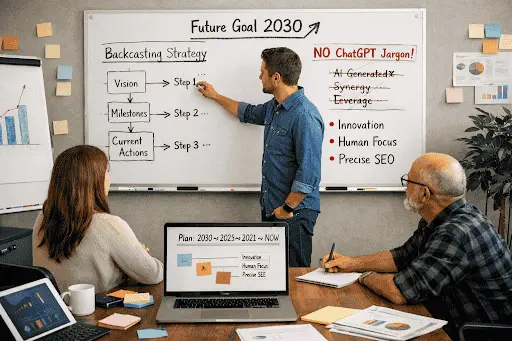
As a digital marketing strategist who has helped businesses reverse-engineer their competitive positioning, I’ve learned that traditional planning often limits our thinking. We ask “what’s realistic given current trends?” instead of “what do we actually want to achieve?” Backcasting flips this approach entirely—it starts with your ideal future, then maps the exact steps backward to today.
Strategic planning methods evolve constantly, and backcasting has emerged as one of the most powerful techniques for long-term success. It enables organizations to envision their desired future state and work backward to the present, creating a clear roadmap for achievement. Understanding and implementing backcasting well can give businesses a significant competitive advantage, especially when combined with the right project management tools.
This comprehensive guide explores what backcasting is, how it differs from traditional forecasting, provides a structured framework for implementation, and examines real-world applications across industries.
Defining Backcasting with Authority
Backcasting is a strategic planning methodology that begins by defining a desired future state, then working backward to identify the steps needed to reach that vision from the present day. According to strategic planning literature and research by John B. Robinson, who coined the term, backcasting originated in sustainability studies focused on developing long-term environmental solutions.
Unlike forecasting, which projects forward from current conditions, backcasting starts with the end goal and provides clear direction for action. This approach removes the limitations of present-day constraints and encourages breakthrough thinking about what’s possible.
Backcasting vs. Forecasting: Understanding the Difference
Understanding the distinction between backcasting and forecasting is essential for effective strategic planning.
Forecasting attempts to predict future states based on current data and trends, which inherently limits planning to incremental improvements within existing constraints. It asks: “Where are we headed based on current trajectory?”
Backcasting, by contrast, ignores current limitations and fosters innovative thinking by envisioning an ideal future and discovering alternative pathways to reach it. It asks: “Where do we want to be, and what needs to happen to get there?”
Backcasting’s freedom from current constraints enables teams to brainstorm ambitious scenarios necessary for transformative change and long-term competitive positioning.
Step-by-Step Framework for Planning a Backcasting Session
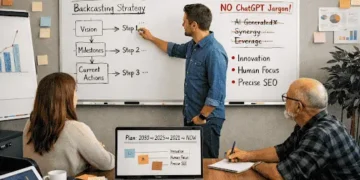
1. Define Future Vision
The first step in a successful backcasting session is articulating a detailed vision of your desired future. This vision must specify expected outcomes and serve as the north star throughout the entire process.
For instance, if your backcasting plan involves digital transformation, you might need to identify skill gaps and evaluate learning platforms like Coursera or Udemy to acquire necessary competencies—integrating professional development into your milestone mapping.
Example: A software company might envision: “In 36 months, we’re the recognized industry leader in AI-powered customer service solutions, with 10,000 enterprise clients and $50M annual recurring revenue.”
2. Map Milestones Backward
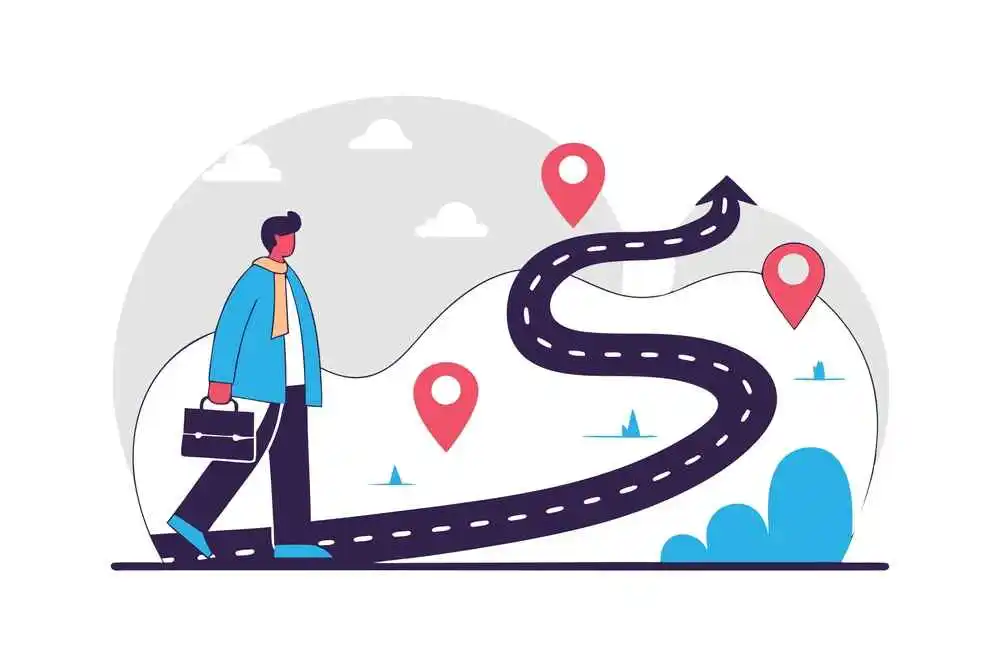
Once the vision is established, reverse-engineer the timeline to identify critical milestones. Breaking the journey into smaller, manageable phases makes strategic planning more actionable and ensures steady progress.
Working backward from the 36-month vision above:
- Month 30: Launch enterprise-grade platform version 3.0
- Month 24: Reach 5,000 clients and establish a case study portfolio
- Month 18: Secure Series B funding and expand sales team
- Month 12: Achieve product-market fit with 500 pilot customers
- Month 6: Complete beta testing with 50 early adopters
- Today: Begin product development and initial market research
3. Identify Present Actions
Next, determine the immediate requirements to initiate progress. These actions should align precisely with your established milestones to facilitate achievement of the overarching objective.
Using project management tools like Notion can help teams organize backcasting milestones, track progress, and document strategic decisions throughout the planning process, ensuring nothing falls through the cracks.
4. Monitor and Adjust Plans
Finally, track progress consistently and remain prepared to modify plans as circumstances change. Adapting tactics dynamically ensures that obstacles and market shifts don’t derail the overall vision.
Tools and Hybrid Formats for Backcasting
Modern strategic planning can take place in physical spaces, digital environments, or hybrid formats using various collaboration tools.
Software such as Miro and Lucidchart creates digital environments for visual collaboration, while project management tools like Notion can help teams organize backcasting milestones, track progress, and document strategic decisions throughout the planning process.
Data dashboards are also essential as they provide real-time analytics and insights, reducing guesswork and enabling data-driven decision-making at each milestone checkpoint.
Recommended Tool Stack:
- Visual mapping: Miro, Lucidchart, Figma
- Project management: Notion, Asana, Monday.com
- Data tracking: Google Data Studio, Tableau
- Collaboration: Zoom, Microsoft Teams for virtual backcasting sessions
Real-World Applications and Case Examples
Backcasting is widely used across sectors, demonstrating its versatility and effectiveness:
Sustainability Planning
Organizations with environmental objectives, such as carbon footprint reduction, use backcasting to map ambitious sustainability goals and develop achievable milestones.
Example: Patagonia used backcasting to envision a fully circular supply chain by 2030, then mapped backward through material innovation, supplier partnerships, and recycling programs—establishing year-by-year targets that transformed their operations.
Corporate Strategy
Companies employ backcasting to establish not only short-term strategic goals but also long-term market leadership positions, ensuring all operations align with sustainable growth objectives.
For service-based businesses, backcasting can transform digital marketing strategies. For example, a dental practice aiming to dominate local search results might envision being the top-ranked provider in their area within 18 months, then backcast the necessary steps: website optimization, review generation campaigns, local citations, and content creation—working backward from the goal to present-day actions.
Similarly, plumbing companies can use backcasting to rank higher on Google by first defining their ideal search visibility (e.g., first-page rankings for 10 key service terms), then mapping backward through content creation, technical SEO improvements, and reputation management—each milestone dated and assigned to team members.
Urban Development

City planners use backcasting to create smart city models that anticipate future needs while balancing social, economic, and environmental factors.
Example: Stockholm’s Vision 2040 used backcasting to envision a fossil-fuel-free city, then worked backward to establish transportation infrastructure, building codes, and energy systems needed at each decade marker.
Policy Design
Government agencies and non-governmental organizations adopt backcasting to design comprehensive policies that address future societal needs and ensure goal attainment.
Comparison with Other Strategic Methods
Understanding how backcasting complements other planning methodologies provides a complete strategic toolkit:
Forecasting
Forecasting excels at predicting near-term trends but lacks the transformative vision that backcasting provides. Use forecasting for 1-3 year operational planning, and backcasting for 5-10 year strategic vision.
Scenario Planning
Scenario planning explores multiple potential futures to prepare for uncertainty, but doesn’t commit to a single desired outcome. Backcasting provides the focused direction that scenario planning lacks—use them together: scenarios identify possibilities, backcasting commits to one and maps the route.
Roadmapping
Unlike roadmapping, which presents a linear progression of planned developments, backcasting permits paradigm-shifting thinking that helps organizations imagine breakthrough futures and unconventional solutions. Roadmaps work well for product development timelines; backcasting works for organizational transformation.
Conclusion
Backcasting is a powerful strategic planning framework that helps organizations envision their desired future and implement step-by-step pathways to achievement. By understanding its advantages, utilizing appropriate collaboration and tracking tools, and applying proven methodologies, businesses can leverage backcasting to drive sustained success and continuous improvement.
The key difference from traditional planning is simple but profound: instead of asking “what will happen?” backcasting asks “what do we want to happen?”—then builds the bridge from vision to reality.
Mastering backcasting skills will help your business remain innovative, adaptable, and forward-thinking while maintaining a competitive edge in your industry. Whether you’re planning sustainability initiatives, corporate transformations, product launches, or market positioning, backcasting provides the clarity and direction needed to turn ambitious visions into achievable realities.
FAQs
What is a backcasting room?
A backcasting room is a collaborative space—either physical or virtual—where stakeholders gather to conduct backcasting sessions. This environment is equipped with visualization tools, whiteboards, digital collaboration software, and data resources to facilitate strategic planning workshops.
Why is backcasting important?
Backcasting is crucial because it enables organizations to develop breakthrough strategies without being confined to incremental improvements. It drives long-term success by starting with the desired outcome and ensuring all actions align with that vision, rather than being limited by current constraints.
How can backcasting be applied in small businesses?
Small businesses can leverage backcasting to define clear growth targets and align operational plans with long-term goals, ensuring every decision moves them toward their vision rather than simply reacting to market conditions.
Can backcasting be integrated with other planning methods?
Yes, backcasting works exceptionally well alongside scenario planning and forecasting approaches. This integration creates a comprehensive planning toolkit that combines long-term vision with near-term realism and contingency preparation. Organizations can use forecasting for annual planning, backcasting for 5-year vision, and scenario planning to stress-test their strategy.
What are the challenges of backcasting?
The primary challenge is maintaining commitment to the vision while adapting tactics as circumstances change. Backcasting requires strong leadership, organizational buy-in, and willingness to make decisions that may seem counterintuitive based on current conditions but are essential for achieving the desired future state.