




































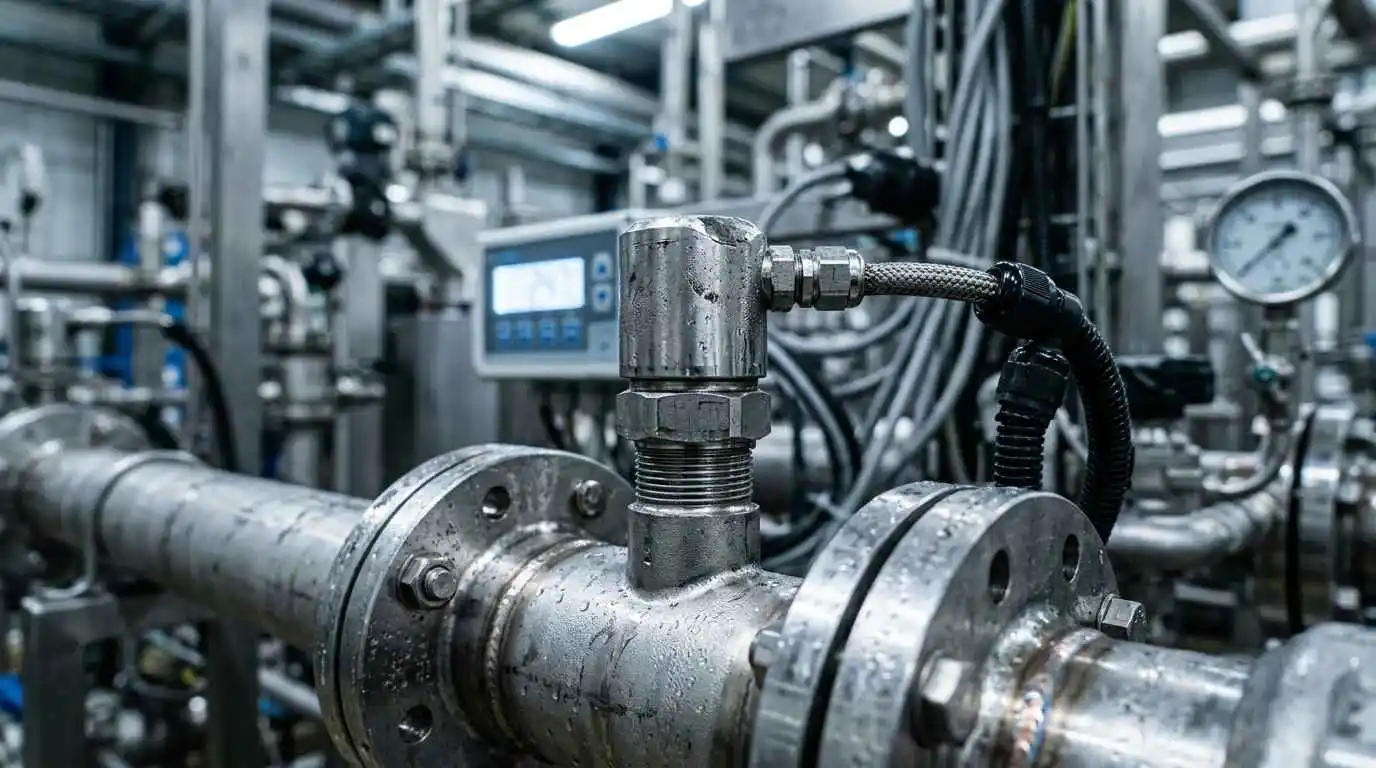
Messonde usually means a measuring probe, and it may be taken as a variation of the German term for a measuring instrument called “Messsonde”. In general, a measuring probe is a device or sensor assembly that is employed for measuring some kind of physical or chemical parameter like temperature, pressure, oxygen, conductivity, level, or radiation. The particular instrument may vary depending on the method of measuring.
Messonde that you came across while searching through a translation of some manual or specification is probably meant to be a measuring probe rather than a software solution or a company name.
What Does Messonde Mean?
Messonde means a measuring probe from a technical perspective. The word is connected to the German word Messsonde, where Mess- has something to do with measurement, while Sonde stands for a probe or device that can be used for investigating or measuring.
In terms of engineering language, a measuring probe is the element of a measuring system which acts with the substance, environment, or process being measured.
For instance, the probe could be put:
- In a liquid tank
- On a surface
- In the foodstuff
- In a flow of gas
- In a laboratory specimen
- In industrial equipment
- Near the source of radiation
- At a certain point in an environmental measuring system
The probe senses some feature and gives a response, which could be converted into a measurement.
It is important to note that the term Messonde does not usually refer to a particular type of instrument. The term should rather be considered as a description of function. The structure of the probe varies based on the parameter that must be measured.
For instance, a temperature probe may employ either a thermocouple, an RTD, or a thermistor; a level probe may use capacitance, pressure, radar, ultrasound, or other principles of measurement.
This is important because a person who is looking for Messonde’s meaning will most likely assume that it means one exact instrument, but it does not have to be so.
Messonde vs. Messsonde: Why the Spelling Matters
 The correct spelling to use when searching for information on technical publications in German is Messsonde, whereas the spelling Messonde could be a simplified or wrong translation of the word.
This spelling difference can create confusion when you search for a product.
This spelling difference can create confusion when you search for a product. Suppose a translated equipment manual says “Messonde.” Searching only that spelling may produce a mixture of technical pages, low-quality articles, and unrelated websites. Searching for Messsonde, along with the actual measurement type, can produce much better results. A single letter or character can completely change what you’re actually looking for the same kind of confusion shows up in other technical terms too, like the practical difference between HTTP vs HTTPS, where one letter changes the entire security model.
Try searches such as:
- Messsonde temperature
- Messsonde level measurement
- Messsonde oxygen
- Messsonde conductivity
- Messsonde radiation
- Messonde measuring probe
- Messonde sensor
The surrounding technical words are often more important than the spelling alone.
Messsonde vs. Messonde
The difference can be summarized simply:
| Term | Practical meaning |
| Messonde | Commonly used online as a spelling associated with a measuring probe |
| Messsonde | German technical spelling associated with a measuring probe |
| Measuring probe | Natural English description |
| Sensor | Broader English term for a device or element that detects a measurable property |
If you are following the German specification sheet, it is better for you to start your research from Messsonde. If you are writing in English, then a measuring probe is more suitable for you.
How does a measuring probe work?
It is a device that measures certain physical and/or chemical properties and converts them into measurable signals.
Usually the process goes in the following way:
1. The interaction of the probe with the material that is being measured
The probe may be in direct contact with the measured material, or it may measure it without any physical contact with it.
For instance, a temperature probe may contact food, liquids, or the surface of machines. Level sensors may detect the quantity of materials in the tank without making any contact with the material.
2. Sensing element detects change
There is a sensing element in the probe which is used for measuring particular measurements.
A thermocouple detects the temperature. A pressure sensing cell detects pressure. A conductivity probe detects the conductivity of liquids.
3. The response becomes a signal
The physical response is converted into an electrical signal or another measurable output.
4. A meter, controller, or computer interprets the signal
The output can then be displayed as a number, chart, warning, or control signal.
This is why a Messonde should not always be treated as the entire measurement system. In many applications, the probe is one part of a larger system that includes wiring, signal conditioning, a transmitter, software, a display, and a control system.
Common Types of Measuring Probes
There is no single universal Messonde design. The right probe depends on the property being measured.
Temperature Probes
Temperature probes measure heat and are among the most common types of measuring probes.
Common technologies include:
- Thermocouples
- RTDs
- Thermistors
- Digital temperature sensors
In the United States, temperature measurements are commonly displayed in degrees Fahrenheit (°F), although degrees Celsius (°C) remains standard in scientific and industrial documentation.
For example, OMEGA manufactures thermocouple probes for industrial and food applications. One of its penetration probes is designed for applications such as frozen food and industrial measurement, with versions supporting different thermocouple types.
A food-processing probe may also use stainless-steel construction and a design intended for hygienic applications.
Oxygen and Gas Probes
Gas and oxygen probes measure the concentration or presence of a specific gas.
They can be used in:
- Combustion systems
- Automotive exhaust
- Industrial processes
- Environmental monitoring
- Laboratories
The sensing technology depends on the gas and required accuracy.
Conductivity and Salinity Probes
Conductivity probes measure how easily an electrical current passes through a liquid.
They are useful for applications involving:
- Water treatment
- Industrial wastewater
- Laboratory testing
- Chemical processes
- Salinity measurements
Because dissolved substances affect conductivity, these probes can provide useful information about water or other liquids.
Level Probes
Level probes determine how much liquid or solid material is present in a tank, vessel, silo, or other container.
Industrial manufacturers such as VEGA offer level measurement technologies based on radar, guided-wave radar, ultrasonic, capacitive, hydrostatic, and radiometric principles.
For example, VEGA’s VEGACAL 62 is a capacitive rod probe designed for continuous level measurement of bulk solids and non-conductive liquids.
Coating and Thickness Probes
Some measuring probes determine the thickness of a coating or material.
These are commonly used in:
- Manufacturing
- Automotive production
- Metal finishing
- Quality control
- Corrosion inspection
The measurement method can vary according to the material and coating.
Where Are Messonde-Type Measuring Probes Used?
 A Messonde can appear in many technical environments because measurement is fundamental to engineering and industrial control.
Industrial and Process Engineering
Factories rely on measurement systems to monitor temperature, pressure, level, flow, density, and other process variables.
A probe may continuously monitor a production process and send its results to a controller.
For example, a level sensor in a storage tank can determine whether a material level is rising or falling. A control system can then use that information to start or stop pumps or trigger an alarm.
VEGA’s industrial measurement portfolio illustrates how level and pressure sensors are used across chemical, pharmaceutical, food, water, wastewater, energy, and other industries.
Radiation Monitoring
Radiation measurement is another important example of a measuring-probe concept.
Germany’s Federal Office for Radiation Protection (BfS) operates the ODL network for continuous monitoring of ambient radiation levels across Germany. The BfS states that the network contains around 1,700 measuring stations distributed nationwide and is designed to identify increased radiation levels quickly.
This is a useful example because it shows why the word “probe” should not be limited to simple temperature instruments. Measurement equipment can be part of large-scale public monitoring infrastructure.
The BfS also documents the technical limits of radiation measurements. For example, its technical reporting explains how background radiation can make small contributions from a distant contamination source difficult to detect.
In other words, accurate measurement is not simply about putting a probe somewhere and reading a number. Instrument design, calibration, measurement distance, environmental conditions, and uncertainty all matter.
Automotive and Exhaust Testing
Automotive systems use sensors and probes to measure conditions inside engines and exhaust systems.
Oxygen measurement is particularly important for combustion control and emissions-related testing.
A probe in an exhaust environment has to operate under conditions that can include high temperature, vibration, chemical exposure, and rapidly changing gas composition.
Food and Kitchen Applications
Measuring probes are also common in food preparation and food production.
A simple food thermometer can use a probe to measure the internal temperature of food. Industrial food facilities may use more advanced temperature sensors for process monitoring.
OMEGA, for example, offers food-service thermometers using thermistor and thermocouple probes. Its specifications include both Celsius and Fahrenheit models and stainless-steel probe construction.
This makes the concept easy to understand: the probe is the part that interacts with the food, while the instrument converts that response into a temperature reading.
Laboratory and Water Testing
Laboratories use many different probe technologies to measure properties such as:
- pH
- Conductivity
- Dissolved oxygen
- Temperature
- Pressure
- Chemical concentration
Water-treatment systems also depend on sensors and probes for monitoring process conditions.
The exact instrument depends on the property being measured and the required accuracy.
Messonde vs. Radiosonde vs. Sensor
The terms Messonde, radiosonde, and sensor can sound similar because they all relate to measurement. However, they are not interchangeable.
| Feature | Messonde / Measuring Probe | Radiosonde | Generic Sensor |
| What it is | A measuring probe or probe-type measurement device | An atmospheric instrument package carried by a weather balloon | Broad term for a device or element that detects a property |
| Main purpose | Measures a specific physical or chemical value | Measures atmospheric conditions at different heights | Detects a physical or chemical change |
| Typical location | Industrial equipment, laboratories, tanks, food systems, environmental equipment | Upper atmosphere | Cars, phones, machines, appliances, industrial systems |
| Possible measurements | Temperature, level, conductivity, oxygen, thickness, radiation, etc. | Temperature, pressure, humidity, wind and related atmospheric variables | Depends on sensor type |
| Communication | May connect to a meter, controller, or computer | Transmits observations to a ground station | May be wired or wireless |
| Balloon required? | No | Normally associated with balloon-borne weather observations | No |
| Main context | Measurement equipment | Meteorology | General technology |
What Is a Radiosonde?
A radiosonde is an atmospheric instrument used in combination with a weather balloon to lift it.
The information from NOAA’s official radiosonde page shows that the radiosonde measures vertical profiles of temperature, humidity, wind speed and direction, pressure, and geopotential height.
The radiosonde may fly for over two hours, attaining heights of over 115,000 feet, according to NOAA. GPS determines the position of the radiosonde and thus wind data is calculated.
That makes a radiosonde very different from the ordinary measuring-probe meaning of Messonde.
The two terms share a measurement concept, but their applications are different.
Is “Messonde” a Software or Brand Name?
 There is no reason to assume that Messonde is software simply because you find the term on a website or in an online search.
The strongest technical interpretation is still measuring probe, particularly when the word appears alongside German engineering terminology or translated equipment documentation.
A website may use “Messonde” as a product name, software label, company name, or marketing term. That does not mean the word itself universally refers to that product.
Before trusting a page, look at the surrounding information.
Ask:
- Does the page identify a manufacturer?
- Is there a real product model number?
- Is there a technical specification sheet?
- Does the manufacturer have an official website?
- Is there documentation explaining what the product actually does?
- Are there independent or institutional references?
- Does the term appear in a genuine manual or technical catalog?
These checks are especially useful if you encounter Messonde on a website claiming it is a revolutionary software platform, AI tool, communication system, or investment product.
A strange term appearing repeatedly across low-quality websites is not proof that it represents a real technology.This same pattern shows up whenever a term gets repeated across AI-generated content without a primary source we’ve covered this before in our piece on why ChatGPT sometimes gives confidently wrong answers, where fluent-sounding text still isn’t the same as a verified fact.
The Newer “Communication Framework” Meaning: Should You Trust It?
Some newer online pages associate Messonde with a communication framework or software-related concept.
This needs to be treated separately from the established measuring-probe interpretation.
The key distinction is evidence.
A technical term becomes easier to verify when it appears in:
- Manufacturer documentation
- Government publications
- Academic papers
- Engineering standards
- Product datasheets
- University research
- Established technical dictionaries
If a supposed software definition appears only across newly published, nearly identical articles with no developer, documentation, product page, code repository, or independent technical reference, there is not enough evidence to treat it as an established definition.This is the exact same verification problem we ran into in our HQPotner review, where a product name circulated online with no consistent official source behind it the checklist for verifying a claimed product is basically identical either way.
That does not prove that a new software product cannot exist. It simply means the claim needs independent verification.
For readers, the safest approach is to separate the documented technical meaning from newer online uses that lack strong evidence.
How to Choose the Right Measuring Probe
Choosing a Messonde or measuring probe should start with the measurement requirement rather than the name of the device.
1. Identify What You Need to Measure
Start with the actual property:
- Temperature
- Pressure
- Level
- Flow
- Conductivity
- Oxygen
- Radiation
- Thickness
- Gas concentration
Different measurements require different technologies.
2. Check the Operating Environment
Consider where the probe will operate.
Important factors include:
- Temperature
- Pressure
- Humidity
- Chemicals
- Vibration
- Dust
- Corrosion
- Food-contact requirements
- Hazardous-area requirements
A probe suitable for a laboratory may fail in a high-temperature industrial process.
3. Check the Measurement Range
A probe should cover the expected measurement range.
For example, an instrument designed for a moderate temperature range may not be suitable for an industrial furnace.
Always compare the manufacturer’s stated operating limits with your actual process.
4. Check Accuracy and Uncertainty
Accuracy should not be considered alone.
For serious measurement work, look at accuracy, resolution, repeatability, response time, and measurement uncertainty.
NIST’s official policy on metrological traceability explains that metrological traceability involves a documented chain of calibrations connecting a measurement result to specified references. NIST also emphasizes that simply having an instrument calibrated does not automatically make every resulting measurement traceable.
5. Check the Output
The probe may produce:
- Analog output
- Digital output
- 4–20 mA
- Voltage
- Resistance
- Fieldbus communication
- Wireless data
Make sure the output works with your meter, PLC, controller, data logger, or software.If any of this output eventually needs to talk to custom software rather than a standard display, it helps to understand how APIs work even if you’re not a programmer, since that’s usually the layer connecting a probe’s data to a dashboard or app.
6. Consider Calibration
Calibration is important when measurement quality matters.
NIST describes its calibration services as a way to support high-quality measurements and measurement traceability in the United States.
The calibration schedule depends on the instrument, environment, application, risk, and quality requirements.
7. Follow the Manufacturer’s Maintenance Instructions
Probe performance can change because of contamination, wear, corrosion, mechanical damage, or aging.
Regular inspection and appropriate cleaning can help maintain reliable measurements.
Do not assume that every probe can be cleaned in the same way. The correct method depends on the sensing technology and construction materials.
Why Calibration Matters for a Measuring Probe
 A measuring probe can be physically functional and still produce unreliable results.
For example, a temperature probe may appear to work while consistently reading several degrees too high or too low.
That is why professional measurement systems consider calibration and uncertainty.
NIST notes that measurement traceability is a property of a measurement result, not simply a label attached to an instrument. A documented chain of calibration and associated uncertainty is part of establishing traceability. This same traceability principle shows up across other measurement-heavy fields too for instance, the NOAA National Centers for Environmental Information’s weather balloon program documents years of radiosonde data specifically so that measurements stay comparable and reliable over time, not just accurate at a single moment.
For high-value manufacturing, laboratory testing, safety applications, and regulatory work, this distinction is important.
The goal is not simply to obtain a number. The goal is to understand how reliable that number is.
Common Mistakes When Searching for Messonde
If you found Messonde in a manual or online search, avoid these common mistakes.
Mistake 1: Assuming It Is a Brand
The word itself does not automatically identify a manufacturer.
Mistake 2: Treating It as One Specific Device
A measuring probe can use many different sensing technologies.
Mistake 3: Confusing It With a Radiosonde
A radiosonde is specifically associated with atmospheric measurements transmitted from a balloon-borne instrument package.
Mistake 4: Trusting the First Search Result
Obscure technical keywords can attract automatically generated pages. Check primary sources before accepting an unusual definition.This is worth remembering any time you’re using an AI tool for technical research too our comparison of Claude vs ChatGPT for Python beginners touches on how different models handle ambiguous or under-documented technical terms.
Mistake 5: Ignoring the Original Language
If the term came from a German manual, search for Messsonde as well as Messonde.
Mistake 6: Choosing a Probe Without Checking Specifications
Measurement range, environment, output, accuracy, calibration, materials, and installation requirements can all affect whether a probe is suitable.
Bottom Line: What Does Messonde Really Mean?
Messonde is best understood as a measuring-probe term associated with the German word Messsonde. It does not describe one universal machine, sensor, software package, or brand.
A measuring probe can be designed to measure temperature, pressure, level, conductivity, oxygen, thickness, radiation, or other properties. The probe is often only one part of a larger measurement system.
If you found the word in a translated manual, start by searching for Messsonde and then add the measurement type or product model. If you found it on a website claiming that Messonde is software, a communication framework, or another new technology, verify that claim through an identifiable developer and primary documentation.This same discipline applies whenever two closely related technical terms get used interchangeably online — we ran into the same issue clarifying AI vs machine learning, where the difference between two overlapping words genuinely matters if you want to use them correctly.
The most reliable rule is simple: follow the evidence, not the keyword.
Frequently Asked Questions About Messonde
What does Messonde mean?
Messonde generally refers to a measuring probe and is associated with the German technical term Messsonde. It describes a probe or measurement device used to detect a physical or chemical property.
Is Messonde the same as Messsonde?
They can refer to the same basic concept, but Messsonde is the more useful German spelling to search when working with German technical documentation. Messonde is commonly encountered online as a simplified or anglicized spelling.
What is the difference between Messonde and a radiosonde?
A Messonde is a general measuring-probe concept, while a radiosonde is a specialized atmospheric instrument package used with weather balloons. Radiosondes measure variables such as temperature, pressure, humidity, and wind-related information and transmit observations to a ground station.
How does a measuring probe work?
A measuring probe detects a physical or chemical property through a sensing element. The resulting response is converted into an electrical or digital signal and then displayed, recorded, or sent to a control system.
Is there official Messonde software?
There is no basis for assuming that “Messonde” itself is the name of an official software product. If you encounter a software product using the name, verify the developer, official documentation, product page, and independent technical references before treating that definition as established.
Is Messonde a real engineering term or an SEO-invented word?
The measuring-probe interpretation is technically grounded in the German term Messsonde. However, some newer online uses of “Messonde” may be poorly sourced or created for search traffic. Always separate the established technical meaning from unsupported newer definitions.