






























Restaurant local SEO makes your restaurant show up when local people look for places to eat, food types, menus, table reservations, and “restaurant near me”. There are three major ranking factors – relevance, distance, and prominence. By 2026, restaurants need to do Google My Business optimization, reviews, menu, reservation, local content, schema markup, Apple Maps, and AI search optimization.
Why Local SEO Is Different for Restaurants (And Why It Matters More in 2026)
The restaurant industry competes with high purchase intent.
When searching for “nearby Italian restaurant,” “best sushi restaurant downtown,” or “restaurant currently open,” the searcher will likely be further along in his or her decision process than when making a more generic informational search.
This is why local search is particularly important for restaurants, cafés, bakeries, bars, food trucks, and other food-related businesses.
Google has defined the top three criteria for determining local results as relevance, distance, and prominence, as explained in Google’s own local ranking guidance. Relevance describes how good a match the business is for the search term. Distance factors in how far away the business is. Prominence factors in how popular the business is.
The 76% / 24-Hour Conversion Stat, and What It Means for Your Tables
You probably have come across the fact that 76% of individuals who search using their smartphone in a local search will visit the business within 24 hours.
This is from an old study by Google and does not provide a basis for the current 2026 benchmark. Nonetheless, the general idea remains the same: most searches for restaurants happen while the individual is making a decision where to eat.
Examples include searches like:
- “Thai restaurant near me”
- “best burger place open now”
- “dog friendly restaurant”
- “restaurants near [neighborhood]”
- “Italian restaurant with outdoor seating”
- “late night food near me”
are very specific.
Your objective is not just to attract more visitors to your website. Your objective is to make the relevant data available to the hungry consumer.
That means your local presence should answer:
Where are you? What do you serve? Are you open? What does it cost? Can I see the menu? Can I call? Can I reserve? What do customers say?
How AI Overviews, ChatGPT, and Gemini Changed Restaurant Discovery
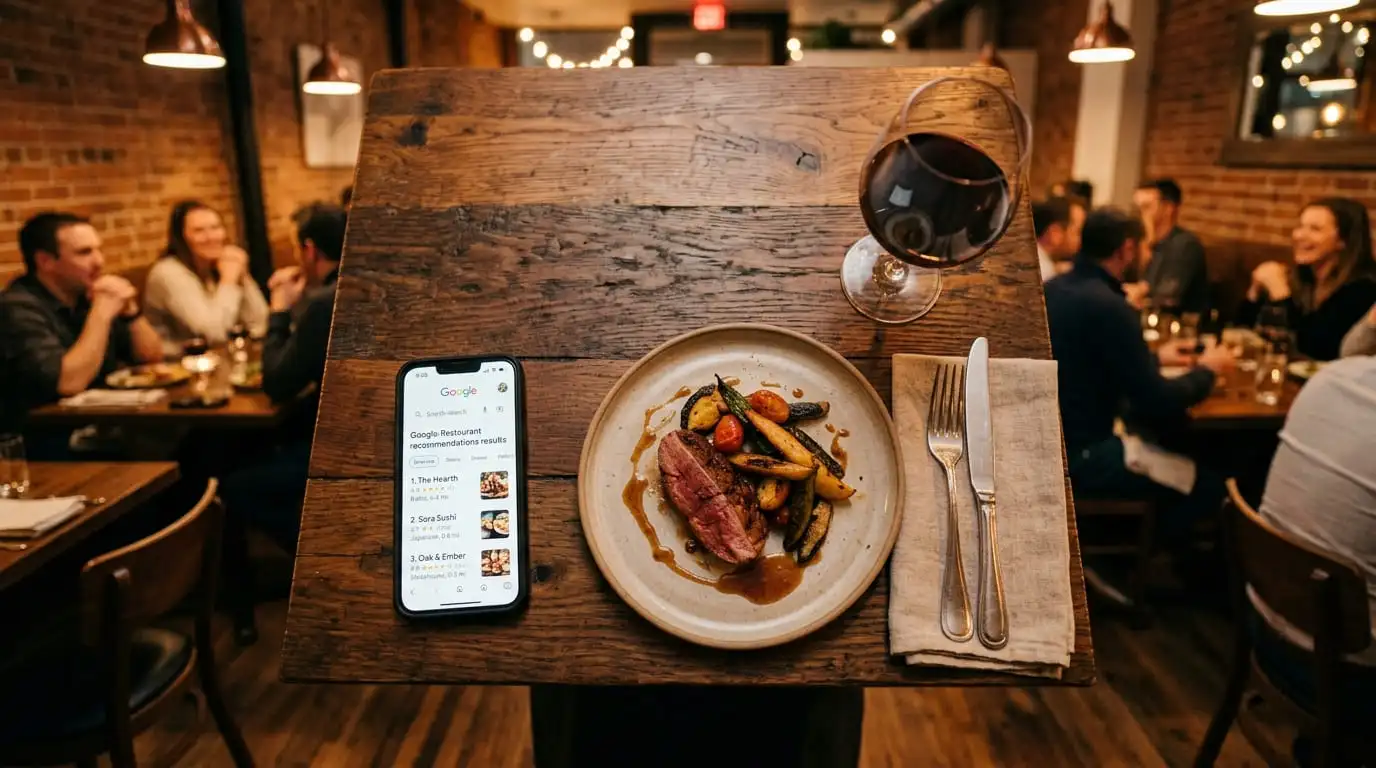 Restaurant discovery is no longer limited to ten blue links.
Customers can now ask Google, ChatGPT, Gemini, Perplexity, and other AI systems questions such as:
“What are the best Italian restaurants near downtown with outdoor seating?”
The systems may use information from websites, business profiles, review platforms, directories, menus, maps, and other publicly available sources.
This makes consistent business information more important.
If your website says one address, your Google Business Profile shows another, and a reservation platform has outdated hours, you create conflicting signals.
For AI search, the practical goal is simple:
Make your restaurant easy to understand, verify, and cite.
Use clear HTML content, structured data, detailed menus, consistent business information, real customer reviews, local mentions, and authoritative third-party profiles.
Google’s 3 Local Ranking Factors: Relevance, Distance, and Prominence
Relevance
Google needs to understand what your restaurant offers.
Your profile should clearly communicate:
- Cuisine
- Restaurant type
- Menu
- Services
- Location
- Amenities
- Dining options
- Special offerings
A Mexican restaurant should not rely only on its brand name. Its website and business profile should make the cuisine and location obvious.
Distance
A restaurant cannot optimize its way into being physically closer to a searcher.
If two restaurants are equally relevant, proximity can affect which one appears for a local search.
This is why neighborhood-level optimization matters.
Prominence
Prominence relates to how well-known and established a business is.
Reviews, links, mentions, citations, and other signals can contribute to a restaurant’s prominence. Google specifically notes that reviews and links from other websites can help its understanding of local prominence.
Restaurant Local SEO Quick-Audit Checklist: Score Your Restaurant 0–100
Give your restaurant 5 points for every item completed.
| Area | Check Item | Points |
| Google Business Profile | Claimed and verified | 5 |
| GBP | Correct primary category | 5 |
| GBP | Accurate hours and holiday hours | 5 |
| GBP | Complete description and attributes | 5 |
| Reviews | Active review acquisition | 5 |
| Reviews | Regular owner responses | 5 |
| NAP | Same business information everywhere | 5 |
| Website | Mobile-friendly | 5 |
| Website | HTML menu | 5 |
| Website | Reservation page | 5 |
| Website | Location / contact information | 5 |
| Schema | Restaurant structured data | 5 |
| Content | Location / cuisine pages | 5 |
| Links | Local backlinks | 5 |
| Apple | Apple Business Connect profile | 5 |
| Delivery | Major delivery listings optimized | 5 |
| Social | Location information included | 5 |
| Tracking | GA4 conversions configured | 5 |
| Tracking | Local rankings monitored | 5 |
| Strategy | 90-day local SEO plan | 5 |
How to Read Your Score
0–40: Start with your GBP, website, reviews, and NAP.
45–70: Your foundation is usable, but several visibility gaps remain.
75–90: You have a strong local foundation and should focus on authority, content, links, and conversion.
95–100: Move from basic optimization to continuous testing and market expansion.
Step 1: Google Business Profile: Your Most Powerful Asset
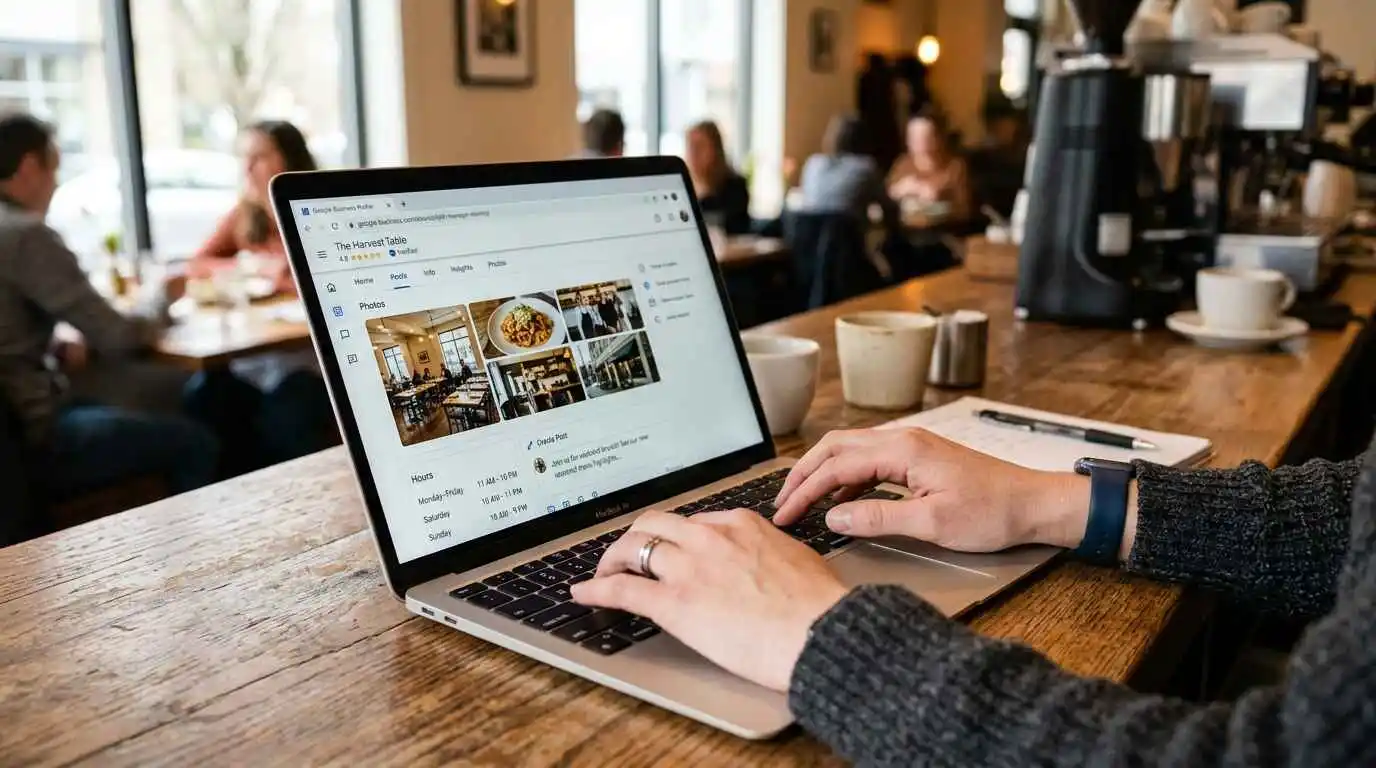 Your Google Business Profile (GBP) is one of the most important assets in local search.
It can influence how your restaurant appears in Google Search and Google Maps and gives potential customers immediate access to your hours, phone number, location, photos, reviews, menu, attributes, and other information.
How to Claim and Verify a Restaurant GBP
Start by searching Google Maps for your restaurant.
If the profile exists, claim and verify it through Google’s official Business Profile process.
If it does not exist, create the business profile using your real business information.
Make sure the following information is accurate:
- Official restaurant name
- Physical address
- Phone number
- Website
- Opening hours
- Holiday hours
- Primary category
- Secondary categories
- Menu URL
- Reservation URL
- Photos
- Business attributes
Never add keywords to the official business name simply because you want to rank for them. If you’re still finalizing your business’s legal setup before registering your GBP, see our LLC vs Corporation guide first.
Choosing the Right Primary and Secondary Categories
Your primary category should describe what your restaurant actually is.
Depending on Google’s available categories in your market, examples may include:
| Category Type | Examples |
| General dining | Restaurant, Family Restaurant |
| Cuisine | Italian Restaurant, Mexican Restaurant, Chinese Restaurant |
| Fast food | Fast Food Restaurant, Hamburger Restaurant |
| Specialty | Seafood Restaurant, Steakhouse, Vegan Restaurant |
| Casual | Cafe, Diner, Bistro |
| Bakery | Bakery, Dessert Shop |
| Coffee | Coffee Shop, Coffeehouse |
| Bar | Bar, Cocktail Bar, Wine Bar |
| Breakfast | Breakfast Restaurant, Brunch Restaurant |
| International | Indian Restaurant, Thai Restaurant, Japanese Restaurant |
| Pizza | Pizza Restaurant, Pizza Delivery |
| Sandwiches | Sandwich Shop, Deli |
| Desserts | Dessert Restaurant, Ice Cream Shop |
| BBQ | Barbecue Restaurant |
| Healthy | Health Food Restaurant |
| Vegetarian | Vegetarian Restaurant |
| Fine dining | Fine Dining Restaurant |
| Buffet | Buffet Restaurant |
| Catering | Caterer |
| Mobile food | Food Truck |
Do not select every vaguely related category.
Choose categories that genuinely describe the business. Google controls the available category set, so verify the current options inside your GBP before publishing.
Writing a GBP Description That Supports Local Search
Your description should sound like a restaurant description, not a keyword list.
Template 1: Local Restaurant
[Restaurant Name] is a [cuisine] restaurant in [neighborhood/city], serving [signature dishes] for [lunch/dinner/brunch]. Guests can enjoy [key attributes], with [reservation/takeout/delivery] available.
Template 2: Specialty Restaurant
[Restaurant Name] brings [cuisine/style] to [city/neighborhood], featuring [specialty dishes]. We offer [dining options], including [patio/private dining/takeout], with [reservation or ordering option] available.
Template 3: Cafe or Bakery
[Business Name] is a local [cafe/bakery] serving [coffee, pastries, breakfast, etc.] in [location]. Our menu includes [specialties], with [dine-in/takeout/delivery] options for customers nearby.
Keep it natural. Do not turn the description into a list of search terms.
Which GBP Attributes Matter for Restaurants?
Use relevant attributes available to your business.
Examples can include:
- Outdoor seating
- Dine-in
- Takeout
- Delivery
- Wheelchair accessibility
- Family-friendly
- Kid-friendly
- Wi-Fi
- Restroom
- Reservations
- Vegetarian options
- Vegan options
- Pet-friendly
- LGBTQ+ friendly
Attributes help customers understand whether your restaurant fits their needs.
Hours, Holiday Hours, and Special Hours
Incorrect hours can destroy trust quickly.
Update:
- Regular hours
- Holiday hours
- Temporary closures
- Special event hours
- Seasonal hours
If your restaurant closes early on Christmas Eve, do not leave the standard schedule active.
A customer arriving at a closed restaurant is unlikely to become a repeat customer.
GBP Photo Strategy
Use real, high-quality photos.
Prioritize:
- Exterior
- Interior
- Dining area
- Signature dishes
- Menu items
- Bar
- Patio
- Staff
- Events
- Private dining
- Parking or entrance where useful
Do not depend on stock photography.
For image SEO, use descriptive file names before uploading, such as:
chicago-italian-restaurant-patio.jpg
rather than:
IMG_8437.jpg
Do not rely on EXIF geotagging as a ranking tactic. Google’s local ranking documentation does not identify EXIF data as a primary local ranking factor.
GBP Posts: What to Post Weekly
GBP Posts can support customer engagement and keep your profile active.
Try rotating these eight formats:
- Weekend special
- New menu item
- Seasonal dish
- Live music announcement
- Holiday event
- Chef feature
- Private dining promotion
- Catering announcement
Example:
New Fall Menu: Our seasonal menu is now available, featuring roasted squash ravioli, apple-glazed pork, and our new spiced pear cocktail. Reserve your table this weekend.
GBP Q&A
Build useful answers around questions customers actually ask.
Examples:
Do you take reservations?
Yes. Reservations can be made through our online booking page.
Do you have outdoor seating?
Yes. Our outdoor patio is available seasonally.
Do you offer vegetarian dishes?
Yes. Several vegetarian options are available on our current menu.
Do not manufacture fake customer questions or use Q&A as a keyword-stuffing area.
Add Your Menu to Google
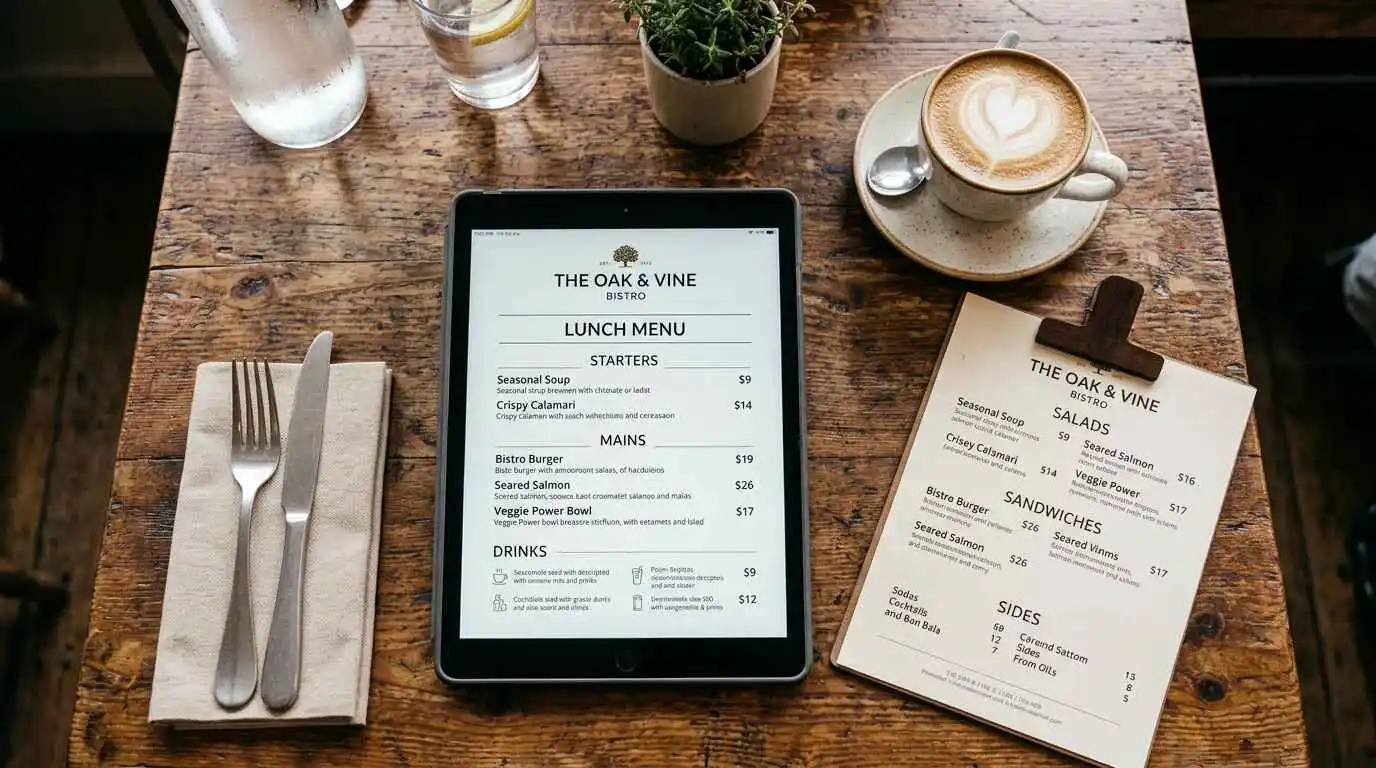 If your menu is available as HTML on your website, link to that page.
A clear menu page is easier for customers and search systems to understand than a menu that exists only inside a PDF.
Where supported, restaurant owners can also use available menu integrations or platform connections.
Step 2: Restaurant Review Strategy: The Make-or-Break Factor
Reviews influence both customer decisions and local visibility.
Google says reviews and positive ratings can help local ranking, while BrightLocal’s 2026 research shows that consumers continue to place substantial weight on review quality, freshness, and star ratings.
BrightLocal’s 2026 survey found that 85% of consumers were more likely to use a business after reading positive reviews, while 77% said negative reviews deterred them.
The 30/60/90-Day Review Velocity Framework
Days 1–30
Create a simple review request process.
Ask customers shortly after a genuine dining experience.
Use:
- QR codes
- SMS
- Receipt links
- Post-visit messages
Days 31–60
Monitor review trends.
Track:
- Review count
- Average rating
- Recent review frequency
- Common complaints
- Common compliments
- Response rate
Days 61–90
Use review language to improve your website and operations.
If customers repeatedly mention:
- outdoor patio
- brunch
- gluten-free options
- steak
- live music
those themes can become useful content and service signals.
How to Ask for Reviews Without Violating Google’s Policies
Ask for honest feedback.
Do not offer:
“Leave us a 5-star review and receive 10% off.”
Do not pressure customers to change a negative review.
Do not selectively ask only happy customers while discouraging unhappy customers from reviewing.
A simple request works:
“If you enjoyed your visit, we’d appreciate an honest review on Google.”
BrightLocal’s 2026 research found that 78% of consumers had been asked to write a review during the previous year, and many of those asked went on to leave one.
Review Response Templates
5-Star Review
Thank you for visiting [Restaurant Name]! We’re glad you enjoyed the food and service. We appreciate you taking the time to share your experience and hope to see you again soon.
3-Star Review
Thank you for visiting and sharing your feedback. We’re glad you enjoyed [specific positive point]. We’re also sorry that [specific issue] did not meet expectations. We’ll review your comments with our team.
1-Star Review
We’re sorry your visit did not meet expectations. We’d appreciate the opportunity to understand what happened. Please contact our team directly so we can review your experience.
Fake Review
Do not publicly accuse the reviewer of being a liar.
Document the issue and use the platform’s reporting process if the review violates its policies.
Detailed Positive Review
Mention the specific detail.
Thank you for mentioning our patio and seafood pasta! We’re happy both stood out during your visit.
Specific responses feel more genuine than repeating:
“Thank you for your feedback.” Strong, specific review responses do more than help rankings — they directly support long term customer retention strategies, since guests who feel heard are far more likely to return.
Yelp vs Google vs TripAdvisor
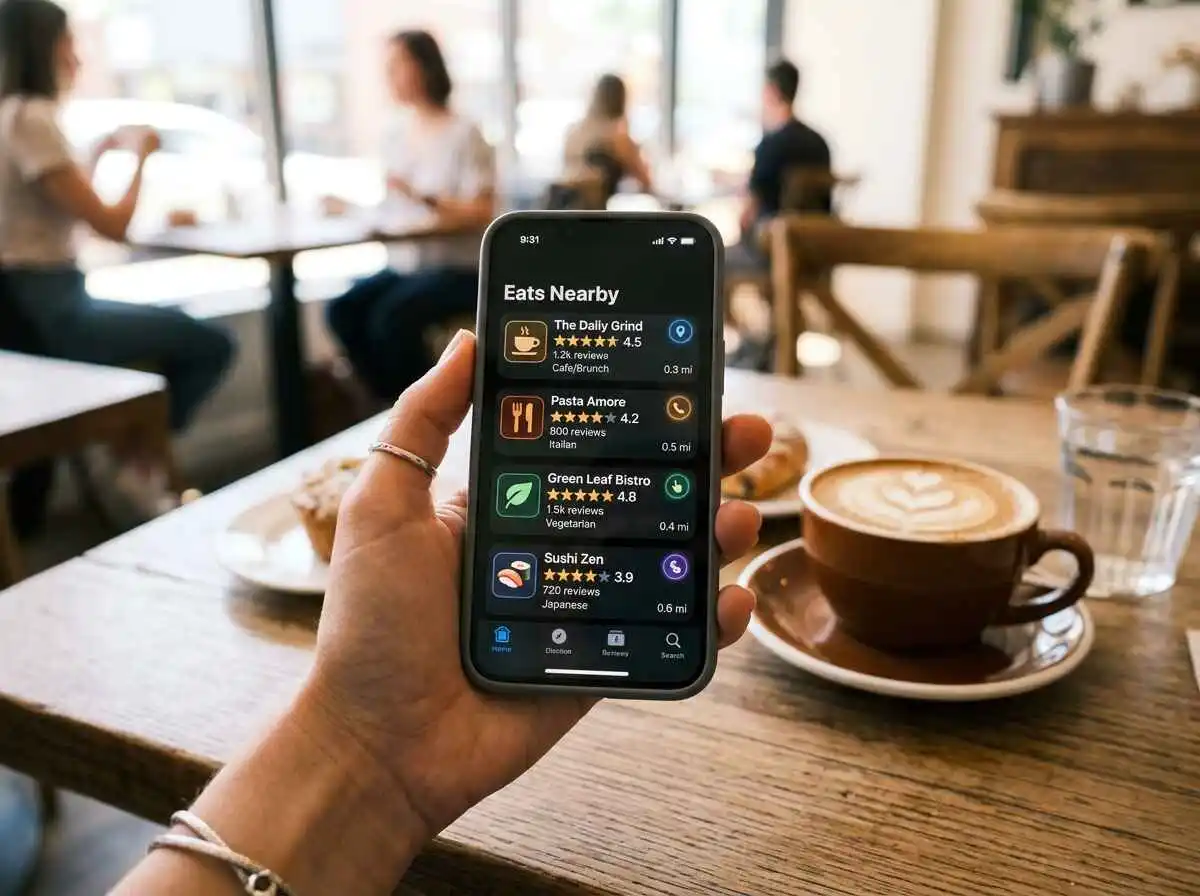 Google should usually receive major attention because of its connection with Search and Maps.
But your restaurant may also benefit from a broader review presence.
BrightLocal’s 2025 research found that 74% of consumers used at least two websites when researching local businesses, reinforcing the value of maintaining consistent information across multiple platforms.
| Platform | Main Value |
| Search, Maps, local discovery | |
| Yelp | Local business discovery and reviews |
| TripAdvisor | Travel and destination-related dining |
| Social discovery | |
| Visual discovery | |
| TikTok | Food discovery and local recommendations |
Step 3: NAP Consistency & Local Citation Building for Restaurants
NAP means:
Name + Address + Phone
Your business information should remain consistent across important websites.
What NAP Consistency Actually Means
If your official address is:
125 Main Street, Suite 200
you should avoid unnecessary variations such as:
125 Main St., #200
across important listings when possible.
The issue is not that Google cannot understand abbreviations. Modern search engines are capable of handling many common variations.
The bigger problem is conflicting information.
If one platform says your restaurant is open until 11 PM and another says 9 PM, customers and search systems receive mixed signals.
25 Important Restaurant Citation Sources
Priority depends on your market, cuisine, and customer base, but a useful starting list includes:
- Google Business Profile
- Apple Business Connect
- Bing Places
- Yelp
- TripAdvisor
- Foursquare
- Yellow Pages
- BBB
- MapQuest
- Chamber of Commerce
- Local tourism website
- Local newspaper
- Local food publications
- OpenTable
- Resy
- Tock
- DoorDash
- Uber Eats
- Grubhub
- Zomato where relevant
- Local restaurant directories
- Local business associations
- City or neighborhood directories
Do not create low-quality listings simply to increase the number of citations.
How to Audit Existing Citations
Search Google for combinations of:
Restaurant Name + Address
and:
Restaurant Name + Phone
Check whether the listings agree.
You can also use tools such as:
- BrightLocal
- Moz Local
- Yext
The right tool depends on how many locations you manage and how frequently your business information changes.
Step 4: Restaurant Website On-Page SEO
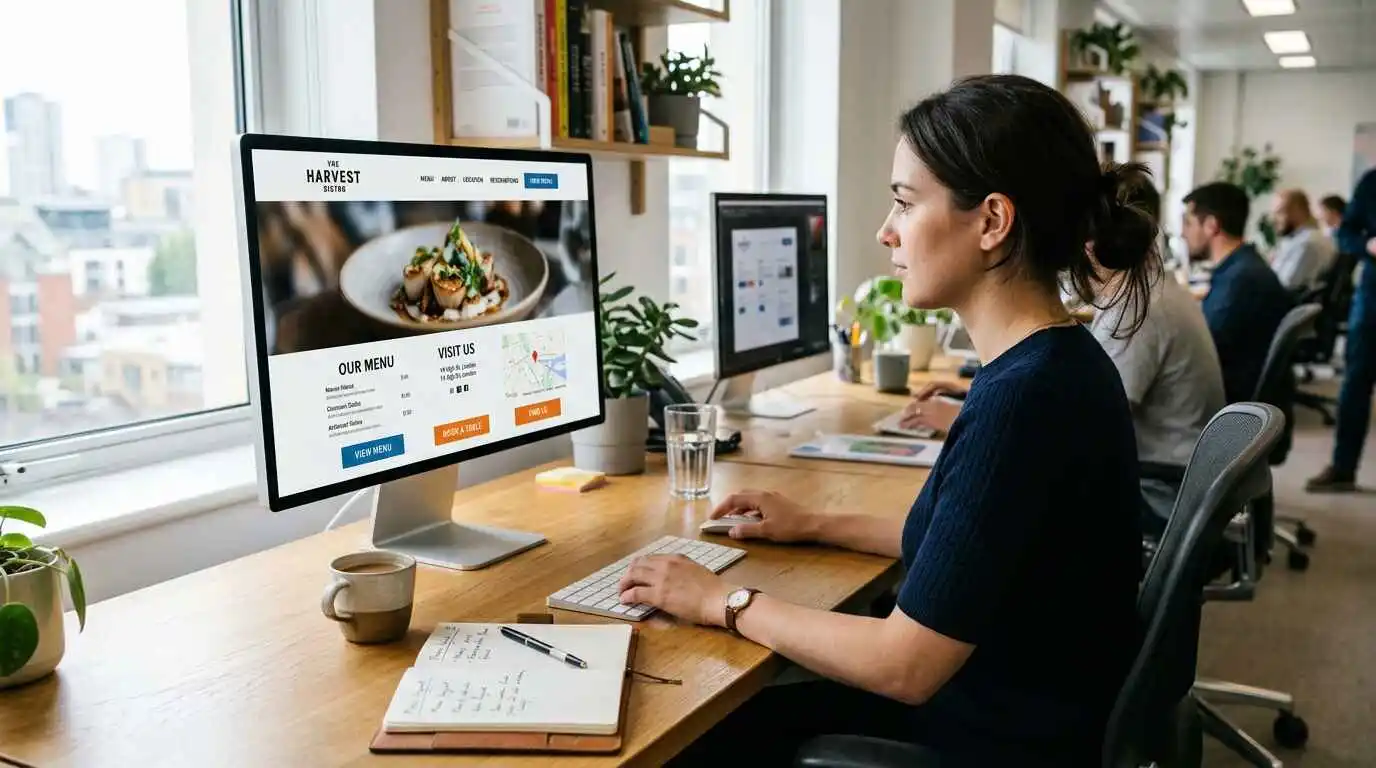 Your website should support every major customer action.
The 7 Core Pages Every Restaurant Needs
1. Home
Explain the cuisine, location, experience, and main conversion action.
2. Menu
Use crawlable HTML content.
3. Reservations
Give customers a clear booking path.
4. Catering
Target catering-related searches.
5. Private Events
Promote birthdays, weddings, corporate events, and group dining where applicable.
6. Contact
Include address, phone, hours, parking information, and map.
7. About
Tell the restaurant’s story, chef background, concept, and local connection.
How to Structure Your Menu Page for SEO
HTML should be the primary menu format.
Instead of:
menu.pdf
create:
/menu/
with real text for:
- Appetizers
- Entrees
- Desserts
- Drinks
- Prices
- Dietary information
- Specials
You can still provide a PDF download if customers want one.
But do not make the PDF the only version of your menu.
Restaurant Title Tag Formula
A useful format is:
[Cuisine] Restaurant in [City] | [Restaurant Name]
Example:
Italian Restaurant in Austin | Bella Roma
For a specific neighborhood:
Italian Restaurant in Downtown Austin | Bella Roma
Meta Description Formula
Visit [Restaurant Name] in [Neighborhood], [City] for [cuisine/signature dish]. View our menu, hours, reservations, and dining options.
For a complete breakdown of writing descriptions that actually earn clicks rather than just filling a field, see how to write a meta description.
Cuisine + City + Neighborhood Keyword Strategy
Use a natural combination of:
Cuisine + Restaurant + City + Neighborhood + Intent
For example:
- Italian restaurant in Austin
- Italian restaurant downtown Austin
- pasta restaurant near South Congress
- Italian restaurant with outdoor seating
- private dining Italian restaurant Austin
Do not create dozens of nearly identical pages for every nearby neighborhood.This is closer to semantic SEO than exact-match keyword targeting see our comparison of semantic SEO vs keyword SEO for a deeper explanation.
Internal Linking Model
Your home page can link to:
Menu → Reservations → Catering → Private Events → About → Contact
Then connect relevant blog posts to service pages.
A post about wedding catering should link to your catering page.
A neighborhood dining guide can link to your reservation page.
Step 5: Restaurant Schema Markup With Copy-Paste JSON-LD
Structured data helps search engines understand the entities and information on your page.
Schema.org includes restaurant-related types and supports menu concepts such as MenuItem.
Restaurant Schema
A basic implementation can look like this:
{
“@context”: “https://schema.org”,
“@type”: “Restaurant”,
“name”: “Bella Roma”,
“image”: “https://example.com/images/restaurant.jpg”,
“url”: “https://example.com/”,
“telephone”: “+1-512-555-0100”,
“address”: {
“@type”: “PostalAddress”,
“streetAddress”: “123 Main Street”,
“addressLocality”: “Austin”,
“addressRegion”: “TX”,
“postalCode”: “78701”,
“addressCountry”: “US”
},
“servesCuisine”: [
“Italian”
],
“priceRange”: “$$”,
“menu”: “https://example.com/menu/”,
“acceptsReservations”: “https://example.com/reservations/”
}
Replace every example value with your real business information.
Menu and MenuItem Schema
Schema.org supports MenuItem for individual food or drink items.
A simplified example:
{
“@context”: “https://schema.org”,
“@type”: “Menu”,
“name”: “Dinner Menu”,
“hasMenuSection”: [
{
“@type”: “MenuSection”,
“name”: “Main Courses”,
“hasMenuItem”: [
{
“@type”: “MenuItem”,
“name”: “Chicken Parmesan”,
“description”: “Breaded chicken with tomato sauce and mozzarella.”,
“offers”: {
“@type”: “Offer”,
“price”: “24.00”,
“priceCurrency”: “USD”
}
}
]
}
]
}
Only mark up information that actually appears on your page.
Do not add fake ratings, prices, menu items, or reviews.
Review and AggregateRating Schema
Be careful here.
Do not simply add AggregateRating markup because you want stars in Google.
Structured data must follow Google’s eligibility and content guidelines.
If the rating information is not legitimately represented and eligible, adding markup does not guarantee rich results.
FAQ Schema
Your FAQ section can use FAQPage structured data when appropriate.
However, schema does not guarantee a rich result.
The visible FAQ content should remain useful even if Google does not display enhanced search features.
Speakable Schema
Speakable markup is intended to identify content suitable for spoken delivery.
For restaurant SEO, conversational answers can also help create clearer content for voice-style queries.
Test Your Schema
After implementation, test the page using Google’s Rich Results Test and inspect the generated structured data for errors.
Step 6: Hyper-Local Content & Link Building
Local content should have a reason to exist.
Do not create 50 pages saying:
Best Restaurant in [Neighborhood]
with almost identical text.
Instead, publish information people in your market actually need.
10 Local Content Ideas That Can Earn Links
- Best date-night restaurants in your city
- Guide to outdoor dining
- Local food festival guide
- Restaurant guide near a stadium
- Catering guide for local businesses
- Local wedding reception dining guide
- Food and wine pairing guide
- Farm-to-table supplier story
- Neighborhood dining guide
- Restaurant guide for convention visitors
How to Land Local Press
Create a genuine local story.
Example pitch:
Subject: Local restaurant launches [community initiative]
Hi [Name],
We’re launching [initiative] at [Restaurant Name] to support [local cause/community]. The project involves [specific details]. If you’re covering local food and community stories, I’d be happy to provide additional information and photos.
The story should be newsworthy.
A generic “please feature our restaurant” email rarely provides a strong reason for coverage.
Local Link Sources
Potential sources include:
- Local newspapers
- Food bloggers
- Tourism websites
- Chambers
- Community organizations
- Local event organizers
- Universities
- Food festivals
- Farms
- Breweries
- Wineries
- Local business associations
Step 7: Reservation Engine SEO: The Hidden Gap
Restaurant SEO should not stop when someone reaches Google.
The customer needs a simple path from:
Search → Restaurant → Menu → Reservation
Optimizing OpenTable, Resy, and Tock Listings
Keep your reservation listings accurate.
Check:
- Restaurant description
- Cuisine
- Address
- Hours
- Photos
- Menu
- Reservation availability
- Website
- Phone
- Amenities
Use the same official information across platforms.
How Google Reserve Integrations Work
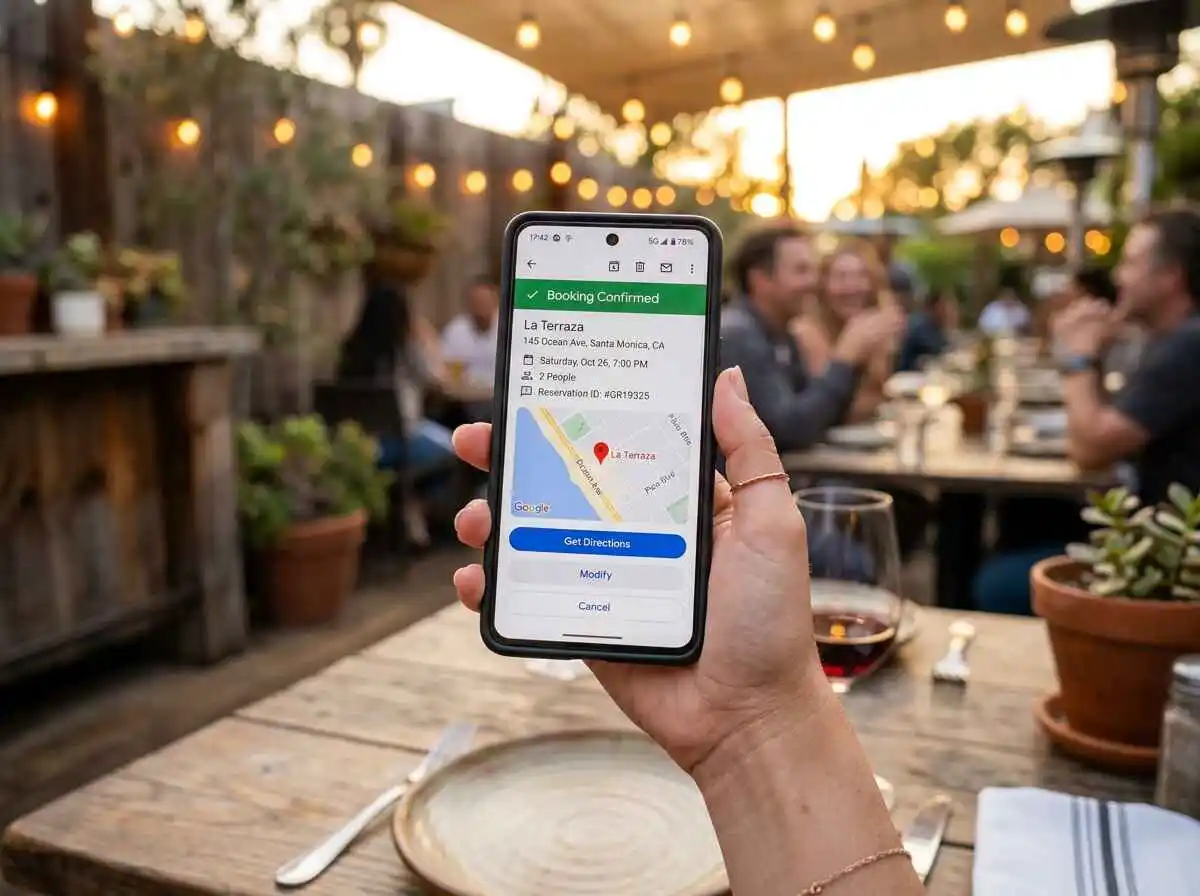 Where supported, reservation providers can connect with Google surfaces.
The exact providers and features available can change by region and platform.
Your goal is to reduce friction.
A customer should not have to:
- Search your restaurant
- Open a random directory
- Find another website
- Search for reservations
- Discover a broken booking button
Make the reservation path obvious.
Own Your Booking Funnel
Third-party platforms can generate discovery, but your own website should remain an important part of the customer journey.
A strong setup is:
Google → Website → Menu → Reservation
while also maintaining:
Google → Reservation Partner
when that integration benefits your restaurant.
Step 8: Food Delivery & Aggregator SEO
Restaurants often have multiple digital storefronts.
Examples include:
- DoorDash
- Uber Eats
- Grubhub
- Restaurant website
- Google Business Profile
Optimize Your Delivery Listings
Use:
- Correct restaurant name
- Accurate categories
- Current menu
- Good food photos
- Correct hours
- Accurate prices
- Descriptive menu item names
- Dietary information
- Delivery area
Do not allow your delivery menu to remain outdated.
How Aggregators Affect Organic Traffic
Aggregator platforms can rank for restaurant and food-delivery searches.
That can bring customers who may never have discovered your website directly.
But your restaurant should still maintain its own website and first-party ordering path when practical.
First-Party Ordering vs Aggregator
| Factor | First-party | Aggregator |
| Customer relationship | Stronger | Platform-controlled |
| Brand experience | Full control | Platform format |
| Discovery | Usually lower initially | Often strong |
| Fees | Can be lower | Platform fees may apply |
| Data access | More control | More limited |
| Convenience | Depends on setup | Usually high |
The right mix depends on your margins, market, technology, and customer behavior.
Step 9: Apple Business Connect & Apple Maps for Restaurants
Google should not be your only local-search platform.
Apple Maps can influence restaurant discovery through Apple’s ecosystem, including Siri and other Apple experiences.
Why Apple Maps Matters
Restaurant customers use different devices, apps, and assistants.
That means your location information should be accurate beyond Google.
Set up and maintain your Apple Business Connect presence where available.
Apple Business Connect Setup
Start with:
- Create or claim your business
- Verify the business
- Confirm the location
- Add accurate contact details
- Add hours
- Add website
- Add photos
- Review category information
- Add relevant business details
- Monitor changes
Do not assume information copied from another platform is always correct.
Siri and Apple Intelligence
AI-assisted discovery increases the value of consistent public information.
A restaurant should clearly communicate:
- Name
- Address
- Cuisine
- Hours
- Menu
- Website
- Reservation options
- Customer-facing attributes
The objective is not to “hack” Siri.
It is to make your restaurant’s information clear and consistent across the web.
Step 10: Optimizing for AI Overviews, ChatGPT, Gemini & Perplexity
AI search changes how customers discover businesses.
Instead of asking:
“Italian restaurants Austin”
someone might ask:
“Where should I take my parents for Italian food in Austin with a quiet atmosphere and outdoor seating?”
That query contains several concepts.
Your content needs to answer those concepts directly.
How AI Engines Pick Restaurant Information
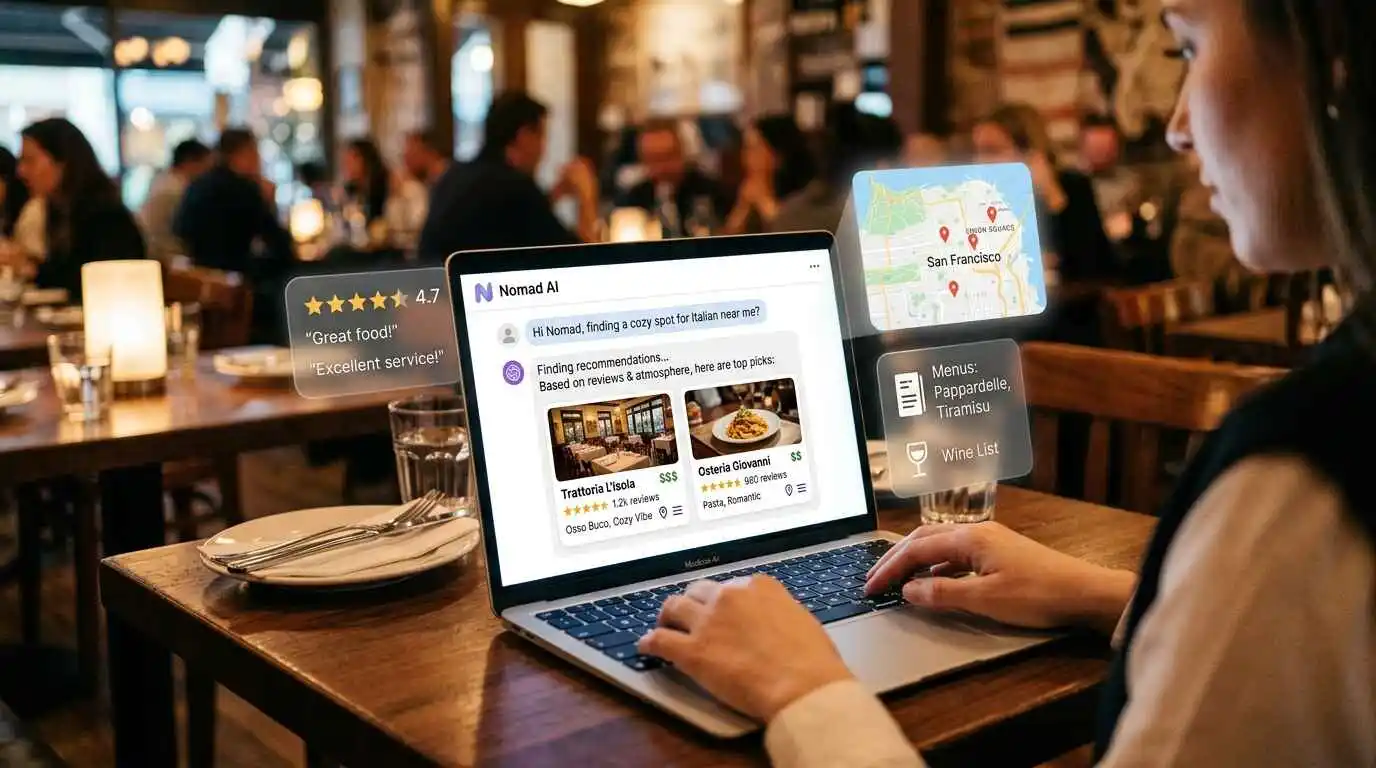 There is no universal formula that guarantees inclusion in ChatGPT, Gemini, Perplexity, or Google AI Overviews.
However, restaurants can improve the quality and consistency of the information available about them.
Focus on:
- Accurate business information
- Clear HTML content
- Detailed menus
- Structured data
- Third-party mentions
- Reviews
- Local links
- Authoritative directories
- Consistent location data
- Useful FAQs
What Content Can Earn LLM Citations?
Create pages that clearly answer questions.
For example:
Does Bella Roma have outdoor seating?
Yes. Bella Roma offers outdoor seating on its seasonal patio in downtown Austin.
Does Bella Roma take reservations?
Yes. Customers can reserve tables online through the restaurant’s reservation page.
What cuisine does Bella Roma serve?
Bella Roma serves Italian cuisine, including pasta, seafood, meat dishes, and desserts.
These direct answer chunks are easy for both people and machines to understand.
A Practical AI Search Example
Suppose a restaurant wants to appear when someone asks:
“Best restaurant in [city] for a birthday dinner?”
The restaurant cannot force an AI system to call it “best.”
Instead, build evidence around relevant attributes:
- Birthday/private dining page
- Event photos
- Menu
- Reservation availability
- Customer reviews mentioning birthdays
- Local publications
- Restaurant profile information
- Structured data
- Clear location information
The goal is to become a well-documented answer candidate, not to manipulate the model.
Step 11: Voice Search Optimization for Restaurants
Voice searches are often conversational.
Instead of:
“Italian restaurant Austin”
a customer might say:
“What’s the best Italian restaurant near me?”
15 Voice-Search Queries Diners May Use
- What restaurants are open near me?
- What is the best Italian restaurant near me?
- Which restaurants have outdoor seating?
- Where can I get brunch near me?
- What restaurants are open late?
- Where can I get gluten-free pizza?
- What restaurants allow dogs on the patio?
- Where can I take my family for dinner?
- What restaurants take reservations near me?
- Where can I get vegan food nearby?
- What is the best steakhouse downtown?
- Which restaurants deliver near me?
- Where can I get breakfast right now?
- What restaurants are near [venue]?
- Which restaurants are good for a birthday dinner?
Create FAQ content that answers these naturally.
Step 12: Mobile, Core Web Vitals & Restaurant Site Speed
Restaurant websites are often image-heavy.
Beautiful food photography is useful, but huge images can make the website slow.
The 3-Second Rule
The often-cited “53% leave after three seconds” statistic comes from older Google research and should not be treated as a universal 2026 benchmark.
Still, speed matters.
Customers searching for food are often impatient.
If your reservation page takes several seconds to load, a customer may leave before booking.
Improve Restaurant Website Speed
Use:
- WebP or AVIF images
- Responsive image sizes
- Lazy loading
- Browser caching
- CDN delivery
- Minified CSS and JavaScript
- Lightweight themes
- Limited third-party scripts
Test your site with Google’s PageSpeed Insights and monitor Core Web Vitals.Make sure every page especially your reservation and menu pages runs on a secure connection; see HTTP vs HTTPS for why this still affects trust and rankings.
Click-to-Call and Reservation Buttons
Put important actions where customers can see them.
Your mobile header can include:
Call | Menu | Reserve
Do not make visitors scroll through three screens to find the phone number.
Step 13: Visual & Video SEO: TikTok, Instagram & Google Images
Food is visual.
That gives restaurants an advantage on image and video platforms.
Geo-Tagging Social Content
When appropriate, include:
- City
- Neighborhood
- Restaurant name
- Location
- Relevant local hashtags
For example:
Austin Italian restaurant + Downtown Austin
Avoid stuffing captions with dozens of location variations.
TikTok and Local Discovery
TikTok can introduce restaurants to customers who were not actively searching on Google.
But do not assume that a TikTok post automatically creates a Google ranking boost.
Use social content to build awareness, branded searches, mentions, and customer interest. For more inspiration on short-form content ideas, see our list of TikTok ideas for small businesses.
YouTube Shorts for Restaurants
Create short videos such as:
- Chef preparing a signature dish
- Restaurant tour
- New menu launch
- Behind-the-scenes preparation
- Patio tour
- Private event setup
- Customer-favorite dish
Use descriptive titles and location context.
Step 14: Seasonal & Event-Driven SEO
Restaurant demand changes throughout the year.
Build pages before customers start searching.
12-Month Restaurant SEO Calendar
| Month / Season | Content Opportunity |
| January | New Year brunch, healthy dining |
| February | Valentine’s Day dining |
| March | St. Patrick’s Day events |
| April | Easter brunch |
| May | Mother’s Day |
| June | Father’s Day |
| July | Summer patio dining |
| August | Back-to-school dining |
| September | Fall menu |
| October | Halloween events |
| November | Thanksgiving dining |
| December | Christmas and New Year’s Eve |
Also target local events:
- Concerts
- Sports games
- Conferences
- Festivals
- Graduation
- Weddings
- Holiday markets
Build Evergreen Seasonal Pages
Instead of creating:
/valentines-day-2026/
consider whether a reusable:
/valentines-day-dining/
page makes more sense.
Then update it every year.
This allows the page to accumulate links, authority, and historical relevance rather than starting from zero annually.
Local SEO for Different Restaurant Types: Pick Yours
Single-Location Independent Restaurant
Focus on:
- GBP
- Reviews
- Menu SEO
- Local links
- Neighborhood content
- Reservations
- Local citations
A single restaurant does not need hundreds of pages.
It needs strong pages that accurately represent the business. These same relevance-distance-prominence fundamentals apply across other local service businesses too we break down the identical approach in our local SEO for lawyers guide, if that’s useful context for comparison.
Multi-Location Restaurant Group or Chain
Each location should have its own landing page.
A location page can include:
- Restaurant name
- Address
- Phone
- Hours
- Menu
- Photos
- Local amenities
- Reservation button
- Parking information
- Neighborhood
- Embedded map
- Location-specific FAQs
Avoid copying the same paragraph onto every location page.
Add genuinely local information.
Cafes and Coffee Shops
Focus on searches such as:
- coffee shop near me
- cafe near [neighborhood]
- coffee and breakfast
- study-friendly cafe
- outdoor coffee shop
- coffee shop with Wi-Fi
Bakeries
Highlight:
- Cakes
- Custom cakes
- Wedding cakes
- Pastries
- Bread
- Breakfast
- Pickup
- Catering
Create dedicated pages when each service is meaningful.
Bars and Cocktail Lounges
Focus on:
- Happy hour
- Cocktails
- Live music
- Sports viewing
- Private events
- Late-night dining
- Outdoor seating
Food Trucks and Pop-Ups
Food trucks have a unique challenge: the location changes.
Keep the permanent business information accurate and clearly publish current schedules.
Use social profiles to communicate temporary locations while keeping the official website useful.
Ghost Kitchens and Cloud Kitchens
Make the service area extremely clear.
Your website should explain:
- Brand name
- Ordering area
- Menu
- Delivery options
- Pickup information
- Hours
Be especially careful about address and service-area information because customers may not visit a traditional storefront.
How to Recover From a Google Business Profile Suspension
A suspended restaurant profile can cause immediate local visibility problems.
Common Reasons Restaurants Get Suspended
Potential issues can include:
- Business information violations
- Incorrect business representation
- Duplicate profiles
- Ineligible locations
- Keyword-stuffed business names
- Suspicious changes
- Guideline violations
- Verification problems
Do not create another profile simply to bypass a suspension.
The 7-Step Reinstatement Process
1. Read the suspension notice
Identify the exact issue.
2. Review your profile
Check:
- Name
- Address
- Category
- Website
- Phone
- Photos
- Business model
3. Remove violations
Correct the underlying problem before submitting an appeal.
4. Gather evidence
Depending on the situation, useful evidence may include:
- Business registration
- Utility documents
- Lease
- Exterior signage
- Website
- Government documentation
5. Submit the reinstatement request
Use Google’s official process.
6. Avoid duplicate profiles
Do not create multiple listings while waiting.
7. Monitor the response
If the appeal is rejected, review the reason and follow Google’s available support process rather than repeatedly submitting identical requests.
Local SEO KPIs & Tracking: What to Measure Monthly
 Traffic alone does not tell you whether restaurant SEO is working.
Track actions that connect to revenue.
Six GBP Metrics to Watch
Monitor available profile performance data such as:
- Searches
- Views
- Website interactions
- Calls
- Direction requests
- Booking or customer actions where available
Do not judge the entire campaign from one metric.
Google Analytics 4 for Restaurants
Track events such as:
- Phone clicks
- Reservation clicks
- Menu views
- Contact form submissions
- Catering inquiries
- Private event inquiries
- Online orders
A useful conversion path is: A useful conversion path is: Organic visitor → Menu → Reservation → Completed booking
For a full setup walkthrough, read our guide on Google Analytics conversion tracking. Tag your reservation and campaign links properly so you know exactly where bookings come from see what is a UTM parameter.
Organic visitor → Menu → Reservation → Completed booking
Local Rank Tracking
Tools such as Local Falcon and BrightLocal can help track local visibility across geographic areas.
Do not obsess over one ranking position.
A restaurant can rank differently depending on:
- Searcher location
- Device
- Query
- Time
- Competition
- Search context
Look for broader visibility trends.
Simple Monthly KPI Dashboard
| KPI | Current | Previous Month | Goal |
| GBP views | — | — | Increase |
| Calls | — | — | Increase |
| Directions | — | — | Increase |
| Website clicks | — | — | Increase |
| Reservations | — | — | Increase |
| Organic traffic | — | — | Increase |
| Menu views | — | — | Increase |
| New reviews | — | — | Increase |
| Average rating | — | — | Maintain/improve |
| Local rankings | — | — | Improve |
If your menu page shows a high exit rate compared to other pages, our explainer on bounce rate vs exit rate shows what to check first before assuming it’s a ranking problem.
Common Restaurant Local SEO Mistakes and How to Fix Them
1. Using Only a PDF Menu
Problem: Search engines and users have less accessible menu content.
Fix: Create an HTML menu page and provide the PDF as an optional download.
2. Choosing a Generic GBP Category
Problem: Google gets weaker information about the business.
Fix: Choose the most accurate available primary category.
3. Ignoring Reviews
Problem: You lose customer trust and miss feedback.
Fix: Create a consistent, policy-compliant review process.
4. Leaving Old Hours Online
Problem: Customers arrive when you are closed.
Fix: Update regular and special hours.
5. Having a Slow Mobile Website
Problem: Customers may abandon the page before seeing the menu or booking option.
Fix: Compress images and improve Core Web Vitals.
6. Creating Duplicate Location Pages
Problem: Near-identical pages provide little local value.
Fix: Add genuine location-specific information.
7. Ignoring Apple Maps
Problem: Your business information may be incomplete in another major mapping ecosystem.
Fix: Claim and maintain Apple Business Connect.
8. Depending Completely on Delivery Platforms
Problem: You have less control over the customer relationship.
Fix: Maintain a strong first-party website and ordering experience.
9. Keyword Stuffing the Business Name
Problem: It can violate platform guidelines.
Fix: Use the real-world business name.
10. Adding Fake Schema
Problem: Incorrect structured data can create eligibility and quality issues.
Fix: Mark up only genuine information visible on the page.
Restaurant Local SEO Cost & Timeline: Honest 2026 Answer
There is no universal restaurant SEO price.
Cost depends on:
- Number of locations
- Website condition
- Competition
- Market size
- Existing authority
- Content requirements
- Technical problems
- Review management
- Link-building requirements
DIY SEO
Best suited to an owner who has time and a manageable single-location restaurant.
You can handle:
- GBP updates
- Basic citations
- Reviews
- Website content
- Photos
- Social content
The main cost is your time.
Freelancer
A freelancer can handle technical SEO, content, local optimization, and reporting without the overhead of a larger agency.
Pricing varies significantly by scope and market.
Agency
An agency may be appropriate for restaurants with:
- Multiple locations
- Competitive markets
- Large websites
- Extensive content needs
- Technical SEO issues
- Ongoing link-building requirements
Avoid choosing an SEO provider based only on a promised ranking position.
No legitimate provider can guarantee a specific Google Maps position.
How Long Does Restaurant SEO Take?
 Some improvements can appear quickly.
For example:
- Correcting hours
- Fixing NAP information
- Improving a menu page
- Adding missing GBP details
can improve the customer experience immediately.
Competitive organic and local visibility generally takes longer.
For a new campaign, 3–6 months is a more realistic planning window for evaluating meaningful progress, although results vary widely by market and starting point.
Conclusion: Your 30/60/90-Day Restaurant SEO Action Plan
Restaurant SEO works best as a system rather than a one-time optimization.
Your Google Business Profile, website, menu, reviews, citations, reservation platforms, social profiles, local links, and AI-search presence should all communicate the same basic story.
Days 0–30: Fix the Foundation
Start with:
- Google Business Profile
- Primary and secondary categories
- Business hours
- Holiday hours
- Photos
- NAP consistency
- HTML menu
- Reservation links
- Restaurant schema
- Apple Business Connect
- Basic GA4 conversion tracking
The first goal is accuracy.
Days 31–60: Build Trust and Content
Next:
- Create a review request process
- Respond to existing reviews
- Build useful local content
- Improve menu SEO
- Create catering/private-event pages
- Clean important citations
- Optimize delivery listings
- Improve reservation-platform profiles
The second goal is relevance and customer trust.
Days 61–90: Build Authority and Measure Results
Then focus on:
- Local backlinks
- Local press
- Food bloggers
- Community partnerships
- AI-search content
- Seasonal landing pages
- Local rank tracking
- Conversion tracking
- Monthly KPI reporting
The third goal is prominence and measurable business outcomes.
The most effective local SEO for restaurants is not about adding the same keyword to every page. It is about making your restaurant easy to find, easy to understand, easy to trust, and easy to book.
When someone searches for your cuisine, your neighborhood, your dining experience, or a place to eat nearby, every important touchpoint should give them a clear answer.
That is the foundation of restaurant local search in 2026.
How We Built This Guide
This guide combines Google’s published local-search guidance, Schema.org documentation, current consumer review research, and practical restaurant SEO workflows.
Google states that local results are primarily influenced by relevance, distance, and prominence.
BrightLocal’s 2026 Local Consumer Review Survey was based on more than 1,000 US adult consumers and provides current insight into how consumers use reviews and AI during local business research.
Schema.org’s current documentation was used to verify restaurant menu and MenuItem structured-data terminology.
Because Google, AI search products, reservation integrations, and business-platform features change frequently, review this article approximately every 90 days and update platform-specific recommendations when official documentation changes.
Frequently Asked Questions
How long does it take to rank a restaurant on Google?
There is no fixed timeline. Local visibility depends on relevance, distance, prominence, competition, business history, reviews, website quality, and other signals. Basic corrections can produce faster improvements, while competitive markets usually require sustained work.
How much does local SEO for a restaurant cost in 2026?
There is no standard price. DIY work may cost little beyond time, while freelancers and agencies charge according to scope. Multi-location restaurants generally require more work than independent restaurants.
Is Yelp still important for restaurants?
Yes, it can still contribute to restaurant discovery and customer research, particularly in markets where Yelp is widely used. However, restaurants should not treat Yelp as a replacement for Google Business Profile.
Can I do restaurant SEO myself?
Yes. A restaurant owner can manage many foundational tasks, including GBP optimization, reviews, citations, website content, photos, and basic analytics. Technical SEO and competitive markets may require additional expertise.
What's the most important factor for ranking in Google Maps?
Google identifies relevance, distance, and prominence as the main local-ranking factors. There is no single optimization that guarantees a Map Pack position.
How many reviews does a restaurant need to rank in the Map Pack?
There is no official minimum number. Review count is only one part of local prominence, and customers also consider review quality, recency, ratings, and the details contained in reviews. BrightLocal's 2026 research shows that review behavior and expectations continue to evolve.
Should I use a PDF or HTML menu?
Use HTML as your primary menu format. You can offer a PDF as an additional download, but important menu information should be available as crawlable webpage content.
Does TikTok help my restaurant's Google ranking?
A TikTok post should not be treated as a direct Google ranking factor. However, social visibility can contribute to awareness, branded searches, mentions, links, and customer discovery.
How do I rank in AI Overviews?
There is no guaranteed optimization method for AI Overview inclusion. Improve the quality and consistency of your restaurant's information across your website, GBP, structured data, reviews, local mentions, and authoritative third-party sources.