



































You use your target keyword in the title, H1 tag, URL, meta description, and body text. You’ve also verified your keyword density. And the page continues to struggle ranking.
That’s when the topic of semantic SEO vs keyword SEO starts becoming relevant.
Keyword optimization is still an aspect of modern SEO practices. Nonetheless, search engines have been able to become more advanced when it comes to contextualization, intent, and entity recognition. A page doesn’t have to focus on one phrase anymore in order to prove its relevance.
Thus, semantic SEO vs keyword SEO isn’t about choosing between legacy SEO techniques and something entirely new. Instead, it is about adapting the way you approach keywords.
In this guide, I will cover what’s the difference between the two SEO approaches, give examples of the same topic optimized through different means, explain when the keyword-based SEO approach is still relevant, and provide a strategy for semantic SEO you can use in 2026.
The key idea here is simple:
Find demands using keywords. Fulfill demands using semantics.
The 30-Second Answer
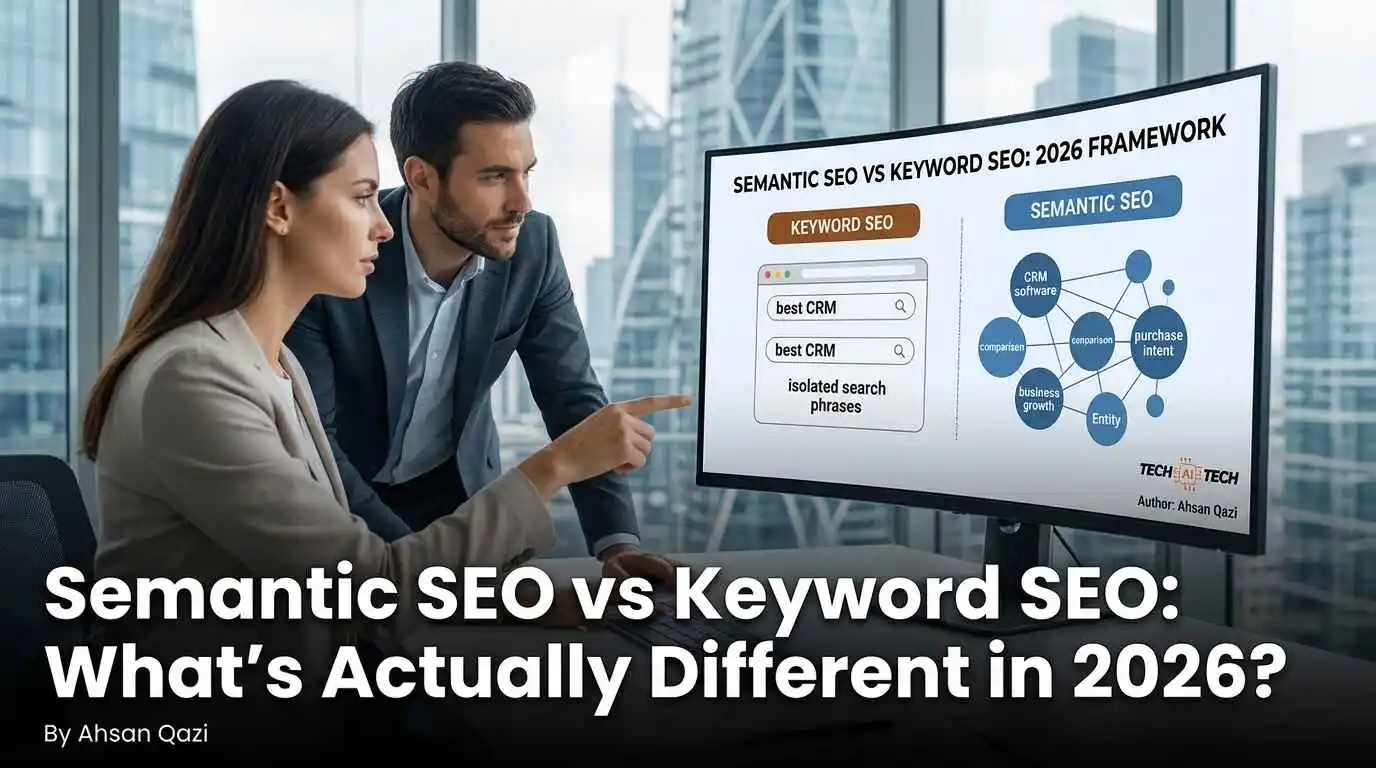
The Semantic SEO approach is concerned with the meaning, context, entities, and relationships linked to the topic. The keyword SEO approach is more concerned about the actual keywords and where they occur on the page.
| Aspect | Keyword SEO | Semantic SEO |
| Main focus | Specific search phrase | Topic and search intent |
| Content approach | Keyword-centered | Topic-centered |
| Main signals | Terms and relevance | Context, entities, relationships, intent |
| Typical structure | One page per keyword | Topic clusters and connected content |
| Writing style | Keyword variations | Natural language and comprehensive coverage |
Semantic SEO and Keyword SEO differ in the sense that current-day SEO does not mean that you have to give up on your keywords but rather use them as pointers to learn about the intent of the users, while the content itself speaks about the topic.
What Is Keyword SEO? The Original Playbook
 Keyword SEO refers to the traditional way of SEO, which involves designing a page using one or multiple target keywords.
For instance, if you want to rank for:
best running shoes for beginners
Then a keyword-based SEO method would put that phrase into the:
- SEO title
- H1
- Introduction
- Subheadings
- Body copy
- Image alt text
- URL
- Meta description
- Internal anchor text
There was also a great focus on keyword density, exact match phrases, and various forms of the main keyword in previous SEO practices.
It was natural when search engines found it significantly more challenging to comprehend context.
But there is a crucial difference between the use of keywords and the overuse of keywords.
In that case, Google still advises putting emphasis on important keywords on the page by asking what people would search for. Google’s own SEO Starter Guide confirms this directly it recommends thinking about the words a user might search for, while also noting that Google’s language matching systems can understand how a page relates to a query even without exact-term matches. This same principle applies when you write a meta description: the keyword still needs to be there, but the description has to genuinely describe the page rather than just repeat the phrase for its own sake.
The issue comes into play when a writer perceives the keyword as the entire topic.
As in the following case:
Best running shoes for beginners are vital since beginners need the best running shoes for beginners. Should you look for the best running shoes for beginners, this guide contains the best running shoes for beginners.
The phrase is quite apparent, but there is no valuable information provided.
The modern web page would focus on the questions which people might have while looking for answers: the cushioning of shoes, fit, type of the surface where one runs, type of foot, durability, drop height, weight, and how often beginners should get new running shoes.
Thus, it leads straight into what is semantic SEO and why the practice became essential.
What Is Semantic SEO? The 2026 Playbook
And then, what is semantic SEO?
Semantic SEO is the optimization technique that involves optimization of content based on the topic and search intent through targeting related entities, concepts, relations, questions, and context, not just one exact keyword.
Think about the difference between these two approaches:
Keyword-first thinking:
“How many times can I use my target phrase?”
Semantic thinking:
“What information would a person need to fully understand this topic?”
That change is at the center of semantic SEO vs keyword SEO.
Semantic optimization generally revolves around three major areas.
1. Search Intent
Search intent is the reason behind a query.
Someone searching for:
best CRM software
may want a comparison.
Someone searching for:
how to choose CRM software
may want educational guidance.
Someone searching for:
Salesforce pricing
has a different intent again.
The words matter, but the reason behind the search matters too.
2. Entities
Entities are recognizable individuals, locations, products, organizations, ideas, and other items that the search engine understands.
If there is a web page on running shoes, some related entities could be:
- Brooks
- Hoka
- ASICS
- Nike
- pronation
- supination
- cushioning
- heel-to-toe drop
- road running
- trail running
These entities help establish the subject and context of a page.
3. Relationships
Semantic SEO also considers how concepts connect.
For example: running shoes → cushioning → impact → comfort → beginner runners
or: SEO → search intent → entities → topical authority → content structure
It is at this point that the idea of the Knowledge Graph becomes relevant. The search engine is able to comprehend the relationships between entities rather than considering all the words just a sequence.
The modern search algorithms depend greatly on natural language processing and machine learning algorithms. Hummingbird, RankBrain, BERT, and subsequent algorithms helped Google to comprehend both queries and content better. If you’re unfamiliar with how these systems actually work under the hood, our explainer on AI vs machine learning breaks down the distinction between the two terms that get used interchangeably in SEO discussions like this one.
To put it simply, semantic SEO means comprehending the entire topic, rather than using one expression again and again.
For example:
running shoes → cushioning → impact → comfort → beginner runners
or:
SEO → search intent → entities → topical authority → content structure
It is at this point that the idea of the Knowledge Graph becomes relevant. The search engine is able to comprehend the relationships between entities rather than considering all the words as just a sequence.
The modern search algorithms depend greatly on natural language processing and machine learning algorithms. Hummingbird, RankBrain, BERT, and subsequent algorithms helped Google to comprehend both queries and content better.
To put it simply, semantic SEO means comprehending the entire topic, rather than using one expression again and again.
The Real Reason SEO Changed: A Quick Algorithm Timeline
The semantic SEO vs traditional SEO discussion becomes much easier when you look at how search has evolved.
| Year | Update/System | What Changed | What Marketers Had to Change |
| 2012 | Knowledge Graph | Connected entities and relationships | Build stronger topical and entity associations |
| 2013 | Hummingbird | Improved understanding of complete queries | Focus less on exact phrases |
| 2015 | RankBrain | Added machine learning to ranking systems | Consider related concepts and query variations |
| 2019 | BERT | Improved understanding of language and word relationships | Write more naturally |
| 2021 | MUM | Expanded understanding across languages and formats | Think about broader topic relationships |
| 2024–2025 | AI Overviews | Search increasingly generated direct answers | Structure content for retrieval and citation |
Hummingbird launched in 2013. It helped Google better handle search questions.
In 2015, RankBrain arrived. After that, machine learning became a key piece of how Google search works.
Then, in 2019, BERT was rolled out. The goal was to improve how Google reads natural language, including word order. Search Engine Land’s technical breakdown of BERT explains that the update was designed to understand words in relation to every other word in a query, rather than processing them one at a time.
In 2021, MUM came next. It is a model that works across multiple modes and multiple languages.
None of this means keywords stopped mattering. It only explains why the focus shifted toward context in search optimization.
Semantic SEO vs Keyword SEO: Same Topic, Two Strategies
 Let’s make the difference practical.
Imagine you want to rank for:
best running shoes for beginners
The Keyword SEO Version
A basic keyword-first article might look like this:
H1: Best Running Shoes for Beginners
The phrase appears repeatedly throughout a 700-word article.
The page lists five shoes and gives each one a short paragraph.
It might discuss:
- Best running shoes
- Best running shoes for beginners
- Beginner running shoes
- Affordable running shoes
The page clearly targets the keyword.
But it may not answer the broader questions a beginner has.
The Semantic SEO Version
A semantic-first article would build the topic around the beginner’s actual needs.
It could cover:
Running surface
- Road
- Trail
- Treadmill
- Gym
Foot and gait considerations
- Pronation
- Supination
- Neutral gait
Shoe characteristics
- Cushioning
- Stack height
- Heel-to-toe drop
- Weight
- Flexibility
- Stability
Brands and products
- Brooks
- Hoka
- ASICS
- Nike
Beginner questions
- How should running shoes fit?
- How often should you replace running shoes?
- Do beginners need maximum cushioning?
- Can the same shoe work for road and trail running?
Notice what happened.
The primary keyword is still present, but the article now covers the concept network surrounding the query.
That is a practical semantic SEO example.
Same Topic, Different Outcome:
Keyword-First Approach |
Semantic-First Approach |
Targets one main phrase |
Targets the complete topic |
Repeats keyword variations |
Uses natural terminology |
Short product list |
Covers products and relevant concepts |
Few supporting questions |
Answers related questions |
One-page focus |
Connects to supporting content |
This does not mean that each semantic page can inherently rank for hundreds of keywords. There are many things that go into the process of ranking, including relevance, competition, authority, quality, link building, and more.
What this means is that by covering your topic thoroughly, you can provide better insight into what your page is all about to the search engine crawlers.
Semantic SEO vs Keyword SEO
The key difference between semantic SEO and keyword SEO is the unit of optimization.
Traditional keyword SEO asks:
“What phrase should this page rank for?”
Semantic SEO asks:
“What topic and intent should this page completely satisfy?”
Here are seven practical differences.
1. Phrase vs. Topic
Keyword SEO usually starts with a target phrase.
Semantic SEO starts with a topic and expands into related concepts.
2. One Query vs. Multiple Related Queries
A keyword-focused page may have one primary target.
A semantically comprehensive page can naturally address many closely related searches.
That does not mean forcing dozens of keywords into the copy. It means answering related questions where they genuinely belong.
3. Keyword Density vs. Context
Keyword optimization can pay attention to how often a term appears.
Semantic optimization focuses more on whether the content provides enough context to demonstrate relevance.
4. Exact Match vs. Natural Language
Keyword SEO can overemphasize exact-match phrases.
Semantic content uses variations naturally.
For example:
“best running shoes for beginners”
can naturally become:
- beginner running shoes
- shoes for new runners
- running shoes for first-time runners
- comfortable shoes for beginners
The writer doesn’t need to force every variation.
5. Isolated Pages vs. Topic Clusters
Traditional SEO often produces individual pages targeting individual keywords.
A semantic SEO approach can connect a pillar page with supporting articles.
For example: SEO Guide → Keyword Research → Semantic SEO → Technical SEO → Internal Linking → Topic Clusters → Search Intent
The internal relationships help users and search engines understand the site’s broader subject coverage. This shift traces back to Google’s Hummingbird update, which Wikipedia’s documented history shows was the first major algorithm change built specifically around interpreting full search phrases rather than individual keywords.
For example:
SEO Guide
→ Keyword Research
→ Semantic SEO
→ Technical SEO
→ Internal Linking
→ Topic Clusters
→ Search Intent
The internal relationships help users and search engines understand the site’s broader subject coverage.
6. Text Matching vs. Entity Relationships
A page isn’t just a collection of words.
It contains concepts and relationships.
A strong page about “WordPress security” might naturally discuss:
- WordPress
- plugins
- themes
- updates
- malware
- authentication
- backups
- firewalls
- vulnerabilities
The relationships between those concepts give the page depth.
7. Traditional Search vs. AI-Assisted Search
The emergence of search experiences using AI gives yet another motivation for writing well-structured content.
For search engines, it becomes necessary to recognize useful content, establish the right context, and relate the answers to credible sources.
Therefore, well-structured, semantically relevant content becomes even more valuable.
One of the reasons why the discussion on SEO vs. modern SEO is not only about keywords anymore.
Semantic Search vs Keyword Search: What’s the Difference?
 The distinction between semantic search vs keyword search is similar but focuses on how search systems interpret queries.
Keyword search primarily looks for matching terms.
Semantic search seeks to figure out the meaning behind the question.
Look at:
“eating places around me open late”
A keyword based system would pick up keywords such as “places,” “eat,” and “late opening.”
A semantic system can interpret the broader intent:
- restaurant or food business
- user’s location
- current opening hours
- late-night availability
That is why conversational searches can work even when the content does not repeat the exact query word for word.
Where Keyword SEO Still Wins
So, is keyword SEO dead?
No.
That would be an oversimplification.
Keywords still help search engines and content creators understand what users are searching for. They are also useful for page titles, headings, URLs, internal links, and content planning.
There are situations where a keyword-first approach remains especially useful.
Branded Searches
If someone searches:
Notion vs ClickUp
the exact terms are closely connected to the topic itself.
Local Commercial Searches
A query such as:”plumber in Dallas” contains a strong location and service signal. You should not hide that phrase simply because you are following semantic SEO principles. This is exactly the logic behind ranking a plumbing business locally on Google: proximity and exact-match local keywords still carry real weight even in a semantic-first
plumber in Dallas
contains a strong location and service signal.
You should not hide that phrase simply because you are following semantic SEO principles.
Product and Comparison Pages
A page targeting one specific product comparison can benefit from clearly matching the searcher’s wording.
The better approach is to combine both methods.
Use keywords to find demand. Use semantics to satisfy it.
That is a much more realistic way to think about semantic SEO vs keyword SEO in 2026.
How to Build a Semantic SEO Strategy
A practical semantic SEO strategy doesn’t require you to throw away your existing keyword research process.
Instead, expand it.
Step 1: Choose a Topic, Not Just a Keyword
Start with the main subject.
Then collect:
- Google autocomplete suggestions
- People Also Ask questions
- Related searches
- Competitor headings
- Customer questions
- Search variations
Your primary keyword becomes the starting point rather than the entire content plan.
Step 2: Map Important Entities
List the concepts an expert would naturally discuss.
For an article about WordPress security, that might include:
- WordPress
- plugins
- themes
- hosting
- SSL
- backups
- malware
- login security
- firewalls
- updates
- vulnerabilities
Don’t add entities just to make a page look comprehensive.
Include them when they genuinely help explain the topic.
Step 3: Build the Outline Before Writing
Group related concepts together.
For example:
Main topic: WordPress Security
Technical protection: SSL, firewall, hosting
Website protection: plugins, themes, updates
Account protection: passwords, MFA, login limits
Recovery: backups, malware cleanup
This creates a logical content structure.
Step 4: Write Naturally
Write for the person who asked the question.
Don’t stop yourself every few sentences to insert a keyword.
If the natural phrase is “beginner running shoes,” use it.
If “shoes for new runners” sounds better in another sentence, use that instead.
The goal is useful language, not mechanical repetition.
Step 5: Connect Related Content
Use internal links to connect your topic cluster.
A pillar article can link to supporting articles, while supporting articles link back to the pillar where appropriate.
Also use:
- descriptive anchor text
- relevant schema
- clear headings
- useful tables
- concise answers
- descriptive URLs
Schema markup does not automatically make poor content rank. Its value is in helping search engines understand structured information where applicable. In the same way that understanding how APIs work, even if you’re not a programmer, helps you grasp why structured data communicates meaning to a machine more reliably than plain prose alone.
Semantic SEO and the AI Overview Era
 Search has also moved beyond the traditional ten-blue-links model.
AI-generated search experiences can synthesize information from multiple sources. That creates new opportunities for Generative Engine Optimization (GEO) and Answer Engine Optimization (AEO).
For semantic SEO, the practical lesson is simple:
Make your information easy to understand, retrieve, verify, and connect to context.
Three useful practices include:
Clear Question-and-Answer Formatting
If a page answers common questions, make those answers easy to identify.
Strong Supporting Sources
When making factual or technical claims, reference credible sources. This matters more than ever now that AI-generated summaries can confidently repeat whatever they find. We’ve covered this exact risk in why ChatGPT sometimes gives confidently wrong answers, where fluent, well-structured text still isn’t a substitute for a genuinely verified source.
Structured Content
Use logical headings, tables, lists, internal links, and relevant structured data where appropriate. Google’s own documentation on structured data explains exactly how this markup helps Google understand entities and relationships on a page, which is the same underlying concept driving semantic SEO.
However, there is no guarantee that semantic content will be cited in an AI Overview or another AI search system.
Search features can change, and citation selection depends on many factors.
The goal should remain useful content first.
The Simple Decision Framework
Not every page needs the exact same SEO approach.
Use this framework when planning content.
Are you creating a product or transactional page?
Start with the important commercial keyword and layer semantic coverage on top.
Are you creating educational content?
Lead with the topic and search intent, then use keywords to guide your research and structure.
Are you trying to appear in AI-generated search results?
Prioritize clear answers, strong topical relevance, useful structure, and trustworthy sources.
Are you building a new website?
Think about topical architecture early.
Instead of publishing dozens of unrelated keyword articles, create logical topic clusters around your main areas of expertise.
This makes semantic SEO vs keyword SEO less of an either/or decision.
In many cases, the strongest strategy is:
Keyword research → semantic content planning → useful content → internal linking → technical optimization
Common Mistakes When Switching to Semantic SEO
Moving away from keyword stuffing doesn’t automatically create semantic SEO.
Here are some mistakes to avoid.
1. Calling Everything a Topic Cluster
Changing category names doesn’t create topical authority.
Your content needs genuine relationships between pages.
2. Making Every Article Extremely Long
A 4,000-word article can still be thin if it repeats the same idea.
Semantic depth is not the same as word count.
3. Ignoring People Also Ask Questions
PAA questions can reveal the subtopics people associate with your main query.
Use them as research inputs rather than stuffing every question into the article. To actually confirm whether your broader topic coverage is working, pair this research with conversion tracking in Google Analytics so you can see which related queries are genuinely bringing in engaged readers, not just impressions.
4. Forgetting Internal Links
Semantic SEO works well with connected content.
A page sitting alone without relevant connections can miss an opportunity to establish broader topical relationships.
5. Removing Keywords Completely
This is one of the biggest mistakes.
Keywords still tell you how people describe a problem.
The goal is not to remove them.
The goal is to stop treating them as the entire SEO strategy.
Final Take: Semantic SEO vs Keyword SEO in 2026
The biggest mistake is treating semantic SEO vs keyword SEO as a battle where one approach must completely replace the other.
Keywords still matter.
They tell you what people search for, help you understand demand, and provide useful direction when planning pages.
But modern SEO requires more than repeating a phrase.
Search engines have become much better at understanding intent, entities, context, relationships, and natural language. Users also expect pages to answer their questions rather than simply contain the phrase they typed.
That is why the practical approach is straightforward:
Use keywords to identify demand. Use semantic SEO to build the answer.
When you combine keyword research with strong topic coverage, logical content architecture, natural writing, internal linking, and useful answers, you create content that is built around people rather than keyword density.
That is the real difference between traditional SEO and modern SEO.
Frequently Asked Questions
What is the difference between SEO and semantic SEO?
SEO is the broader practice of improving a website's visibility in search engines. Semantic SEO is an approach within SEO that focuses heavily on meaning, context, search intent, entities, relationships, and comprehensive topic coverage rather than relying mainly on exact keyword matching.
What is semantic search SEO?
Semantic search SEO means creating and structuring content so search engines can understand the meaning and intent behind a query. It focuses on concepts, entities, relationships, context, and natural language rather than only matching exact words.
Are keywords still important in 2026?
Yes. Keywords remain useful for understanding search demand and communicating page relevance. The important change is how they are used. Modern SEO generally works better when keywords are incorporated naturally into content that fully satisfies the underlying search intent.
Is semantic SEO the same as topical SEO?
They overlap but are not identical. Semantic SEO focuses on meaning, entities, relationships, and intent. Topical SEO focuses heavily on building comprehensive coverage and authority around a subject. A strong topical strategy often uses semantic SEO principles.
Does semantic SEO help with AI Overviews?
Semantically clear and well-structured content can make information easier for search systems to interpret and retrieve. However, there is no guaranteed method for appearing in AI Overviews. Source quality, relevance, authority, query intent, and changing search systems can all affect citation and visibility.
Do I need expensive tools to do semantic SEO?
No. Paid tools can speed up research, but you can begin with Google search results, autocomplete, People Also Ask, related searches, competitor pages, customer questions, and your own subject knowledge. The quality of your topic mapping matters more than simply owning an expensive SEO platform.