



























You invested an entire weekend in that post. You researched it, wrote it, included a couple of images and published it. And now a month later, you don’t even have any traffic on it.
Does this ring a bell? New bloggers often come across this obstacle. Their content is good enough, however, Google does not think that you are the one to say it. What is then EEAT? EEAT means Experience, Expertise, Authoritativeness and Trustworthiness – those are the four factors that Google quality raters use when evaluating your content, and in a blog they are represented through author bios, original content, credible citations, clear policies and links from trusted sources.
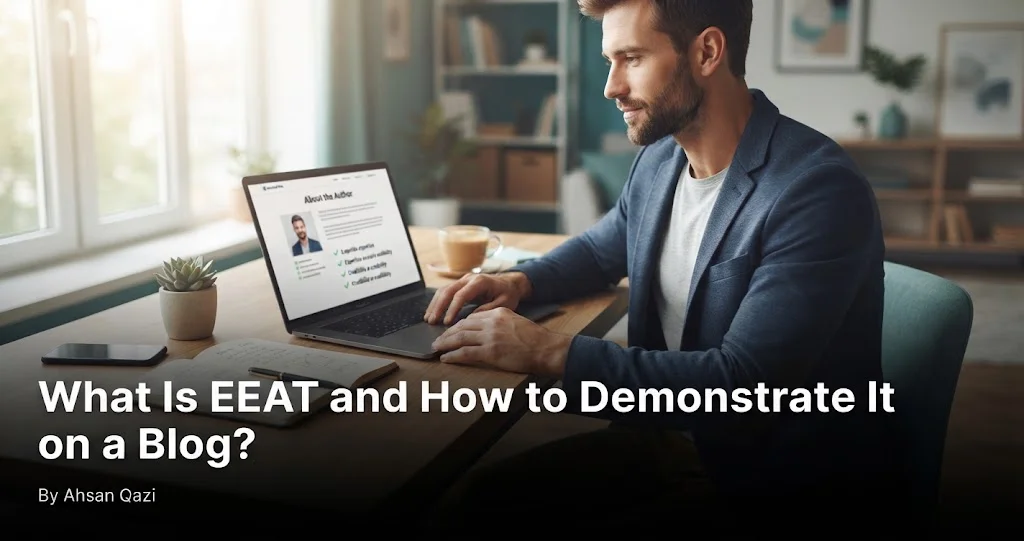
By Ahsan Qazi, who has 5 years of SEO experience and who used these exact steps to promote TechAiTech. You can find my full biography at the bottom of this post. And yes, this was on purpose.
What Is E-E-A-T in SEO? The Four Letters Explained
It is easy to start. EEAT is the acronym for the concept outlined in Google’s official Search Quality Rater Guidelines.This is a lengthy set of guidelines issued by Google to thousands of raters to determine whether the search result is really a quality one.
- E – experience: Is your content based on your personal experience?
- E – expertise: Can you show off the knowledge on the subject?
- A – authoritativeness: Are you considered to be an authority?
- T – trustworthiness: Is your content truthful and reliable?
As you can see, the official guidelines from Google put trust at the heart of it. The other three attributes support trust. As per the guidelines set by Google, a low trust website will definitely have a poor EEAT score no matter what experience and expertise it holds (Google Search Quality Raters Guidelines, chapter 8.3). Consider trust as a roof which stands on three pillars.
One thing to know early: the raters don’t change your rankings. They help Google test whether its systems are working. But the ideas in the guidelines show you what Google wants its systems to reward. That’s why every serious blogger should know them.
EEAT vs. EAT: What Changed in 2022
The idea has been around longer than the extra “E.”
- 2014: Google published its rater guidelines publicly and introduced the EAT concept.
- August 2018: The “Medic Update” hit health and wellness sites hard. Many of them lacked clear expertise and trust signals. SEOs started paying close attention to EAT after this.
- December 2022: Google officially announced the addition of “Experience” and EAT became EEAT.
- March 2024: The Helpful Content system became an integral part of the Google ranking algorithm. Many low-quality mass sites disappeared from sight.
Why add Experience? Because the web filled up with articles written by people who had never touched the thing they were describing. A review of a tent written by someone who never slept in it isn’t much use. Google wanted a way to reward people who had actually done the thing.
Is EEAT a Google Ranking Factor?
 Here’s the honest answer: not directly.
There’s no EEAT score. There’s no meter inside Google that says your blog is a 72 out of 100. Danny Sullivan, Google’s former Search Liaison, put it this way in October 2019: “Not if you mean there’s some technical thing… we do use a variety of signals as a proxy.”
The term “proxy” is quite significant. Google cannot get into your head and examine your diploma. Thus, its algorithms use cues that are normally correlated with quality content. Gary Illyes, Google Search Analyst, stated in his speech at Pubcon in February 2018 that E-A-T depends mostly on references and mentions of an expert nature.
So don’t believe tools that promise to “check your EEAT score.” No such number exists. What you can do is build the real-world signals that line up with EEAT. That’s what the rest of this guide covers.
Why EEAT Matters for Bloggers in 2026
If you started blogging a few years ago, the rules have shifted under your feet. Here’s what’s different now.
Helpful content is part of the core system. Since the March 2024 core update, Google’s main algorithm has judged helpfulness all the time instead of in occasional waves, as laid out in Google’s own guidance on creating helpful, reliable, people-first content. According to Google, it plans to reduce irrelevant content in their searches by around 40%. This is quite a high target and has affected the thin and copy and paste type of blogs most.
AI Overviews depend upon top searches. According to Ahrefs, more than 76% of the links for AI Overviews are made up of those links which are already ranked in the top 10 results.
Brand mentions matter more than ever. In the same Ahrefs research, branded web mentions showed a 0.664 correlation with AI Overview citations. That was the strongest relationship they measured. If people talk about your blog around the web, AI tools notice.
YMYL reaches further than you think. YMYL stands for “Your Money Or Your Life.” This is information which could have repercussions in regards to the health, financial security, safety, and well-being of a person. One does not necessarily require a blog post about medicine in order to qualify for the YMYL category. Finance advice, legal information, diet and exercise programs, and other such content can all fall into this category.
Add one more reason: readers are skeptical. A Moz-cited stat says only 14% of consumers trust brand claims as much as they trust user reviews. People want proof, and EEAT is basically a plan for giving them proof.
The 4 Pillars of EEAT Explained
Experience: Show You’ve Done It
Experience is the newest letter and the easiest one for a small blogger to win. A big brand can’t fake your life. You can.
Here are five ways to do that on a blog:
- Take your own photos and screen captures. Capture your setup, dashboard, and results.
- Write things from your own perspective. “This is what happens to me when using this technique” sounds better than “Users might face these problems.”
- Give inside information. Describe the methodology of your test and the things that went wrong or unexpectedly well.
- Provide short video reviews. A short two-minute screen recording demonstrates that you actually did this work.
- Perform tests for a certain period of time. “I was using this solution for 30 days” is not easy to cheat.
An excellent example is Wirecutter. The “How we tested” section describes in detail the whole procedure and demonstrates the hands-on effort behind each choice.
Expertise: Prove You Know It
There are two types of expertise: formal and non-formal. Formal expertise could be a certificate, a license, or a diploma. Another type of expertise is what Moz calls “everyday expertise,” which is experience in dealing with something in the real world. Thus, parents who coped with picky eaters for ten years can have expertise even without having any diploma.
Formal expertise is important when discussing professional topics such as health, finance and law. In case of hobbies, the experience might be sufficient. Regardless of the type of expertise, one should disclose it to the readers.
An effective author biography consists of information on your background and practice experience, previous projects and publications and, if possible, official certification. Healthline can be considered an example to learn from. In particular, its articles include the name of the author, medical reviewer, fact-check and update information. Of course, you do not need so many people, but you can use the idea.
Authoritativeness: Make Others Vouch for You
You can’t declare yourself an authority. Other people have to do it for you.
Authoritative websites derive their authority from backlinks, brand mentions, guest posts, podcast mentions, and “as seen in” mentions. Quality over quantity wins here. One link from a respected industry site is worth more than fifty from random directories.
Some blogs, like Best Wallet Hacks, put their press mentions right up front where readers can see them. That small touch tells new visitors that others have already vouched for the site.
Trustworthiness: The Master Pillar
Trust is where everything meets. Without it, the rest falls apart.
On a blog, trust means:
- A secure site (HTTPS)
- Easy-to-find contact details
- A privacy policy and terms page
- Disclosures for advertisements, affiliate marketing links, and sponsored posts
- Accurate information with citations
- A true About page
Not being able to identify your blog and how to contact you is a warning sign for both your readers and for the raters. An editorial standards page is an excellent example of commitment to accuracy.
How to Demonstrate EEAT on Your Blog: 14-Step Checklist
 This is the practical section. Think of it as your EEAT check list. Do it in order or go straight to the problem areas.
1. Add detailed author bios
Your blog post must have an author with a picture, credentials, and a LinkedIn profile. Your readers must see who is behind the post. Do this right now by writing a brief 60 to 100-word author bio.
2. Add Person and Article schema
Code that enables search engines to recognize who wrote what is called schema. Here is an example of how one can use the schema “Person”:
json
{
“@context”: “https://schema.org”,
“@type”: “Person”,
“name”: “Your Name”,
“jobTitle”: “SEO Specialist”,
“url”: “https://yourblog.com/author/your-name/”,
“image”: “https://yourblog.com/images/your-name.jpg”,
“sameAs”: [
“https://www.linkedin.com/in/yourprofile”,
“https://twitter.com/yourhandle”
]
}
Using plugins such as Yoast or Rank Math, you will get Article and Person schema for free on WordPress. Look at your author settings and enter all the information about the links to your social profiles. Then test some post using Google’s Rich Results Test. Please do this exercise: use one post in Google’s test today.
3. Create your About page
Forget about the 200 word biography altogether. Put your picture, your story, the reason why you started this blog, and its intended audience. Try this exercise and include one personal story about your blog.
4. Publish your editorial policy
Explain your research, fact-checking and correction processes. Just a short page will be enough. Please do this exercise: write five short points on your policy and put them into the footer of your site.
5. Provide “last reviewed” and “updated” dates
Visitors want to see that content is relevant. Update the date only after you have done changes to the post. Please do this exercise: add “updated on” date in your template.
6. Cite primary sources
Use Google documents, governmental sites, university pages and original studies. Try not to cite other blogs that repeat the same thing. Please do this exercise: find one weak link in your best post and substitute it with a primary source.
7. Use original pictures and screenshots
Websites with stock images are boring. The screenshot will prove that you have checked everything yourself. Please do this exercise: change one stock image with your own screenshot.
8. Implement basic security measures
HTTPS, secure forms and a clear contact page with a real e-mail. Please do this exercise: visit your website and click all the links in the footer.
9. Disclose AI use and affiliate links
Be upfront. A short note near the top of the post is enough. Do this today: add a standard disclosure block to your template.
10. Build topical clusters
Connect posts related to each other to ensure that your website has depth when discussing the subject. People interested in writing better snippets would find our post on how to write a meta description useful as a next read. Readers analyzing their own metrics would equally benefit from a clear explainer like bounce rate vs. exit rate, since it’s exactly the kind of supporting page a topical cluster needs.
Once you’re tracking engagement, the natural next step is setting up conversion tracking in Google Analytics so those topic clusters tie back to real outcomes.
This same clustering approach matters even more in YMYL industries – our local SEO for lawyers guide shows how a trust-sensitive niche can structure its own cluster.
11. Get mentions of your brand
Pitch to journalists using platforms such as Connectively (formerly known as HARO), participate in podcasts and become a guest author in reliable publications. Today do: Respond to one journalist’s query within your niche.
12. Develop other author profiles
Create LinkedIn, X, Muck Rack and About.me profiles and include the links to them in your author bio. This will help Google to associate you with your works. Today do: Make sure all profiles have the same photo and name.
13. Update old articles twice a year
This is especially important for YMYL posts. Update statistics, fix dead links and publish the new date of post. Today do: Make the list of your five oldest articles and pick one for an update.
14. Reduce weak content quarterly
Remove, consolidate or update outdated, duplicate, non-valuable pieces. Your quality blog can be more effective than a large one. Today do: Export your articles of the last three years and mark those which get little or no traffic.
Free EEAT Self-Audit Scorecard
 Want to know where you stand? Score each statement from 0 to 3. Use 0 for “not at all,” 1 for “a little,” 2 for “mostly” and 3 for “fully.”
| # | Signal | Question | Score (0–3) |
| 1 | Author | Every post has a named author with a photo | |
| 2 | Author | Bios list real credentials or experience | |
| 3 | Author | Author profiles link to LinkedIn or other sites | |
| 4 | Trust | HTTPS, privacy policy and contact page are in place | |
| 5 | Trust | Affiliate and AI use are clearly disclosed | |
| 6 | Experience | Posts include original photos, screenshots or tests | |
| 7 | Experience | You write from first-hand use, not just summaries | |
| 8 | Authority | Other sites mention or link to you | |
| 9 | Authority | You’ve appeared as a guest, speaker or source | |
| 10 | Trust | Claims link to primary sources and dates are current |
How to read your score (out of 30):
- 25–30: Strong. Keep publishing and keep earning mentions.
- 15–24: Average. Fix your lowest-scoring group first.
- Under 15: At risk. Start with author bios, your About page and trust basics.
[Download the printable PDF version of this scorecard here.]
EEAT for AI-Generated Blog Content
Let’s be honest: many bloggers now use AI tools. Google’s stance is that AI content is fine if it’s helpful and made for people. What Google dislikes is content made mainly to game rankings.
The numbers show AI is everywhere. An Ahrefs study of 600,000 pages found that 81.9% of content in the top 20 results contained some AI-generated material. So AI use alone isn’t what keeps you off page one.
Here are four rules to keep AI-assisted posts safe:
- Have a human review everything. Read it out loud. Cut anything that sounds vague.
- Disclose your use. A simple line builds trust.
- Fact-check every claim. AI tools can invent stats and sources with total confidence. our breakdown of why ChatGPT gives wrong answers explains exactly where this goes wrong and why verification matters.
- Add something only you can add. Your test results, your photos, your opinions and your mistakes.
That last rule is the secret. AI can summarize what’s already out there. It can’t have lived your experience. When you add your experience, expertise and sources on top of a draft, the post becomes more useful than a generic one. That’s why EEAT can help AI-assisted content rank better, not worse. If you rely on AI tools for parts of your workflow, our guide to AI tools for bloggers under $50 covers which ones still leave room for your own voice.
Common EEAT Mistakes That Tank Blogs
I’ve seen these over and over:
- Anonymous content. No byline, no face, no accountability.
- Stock-image-only blogs. They look like everyone else’s.
- Fake freshness. Changing dates without changing content is easy to spot and erodes trust.
- Hidden affiliate links. Readers feel tricked, and so does Google.
- Scaled content abuse. Publishing hundreds of thin AI posts is exactly what t Google’s official spam policies target.
- Site reputation abuse. Renting out a subdomain to unrelated third-party content to borrow your site’s authority is also against Google’s spam policies.
- Ignoring YMYL standards. The 2018 Medic Update showed how quickly sites on sensitive topics can fall when trust signals are missing.
If any of these sound like your blog, don’t panic. Every one is fixable.
How Long Until EEAT Improvements Show Results?
 Short answer: don’t expect overnight change.
SEO expert Lily Ray has noted that Google’s reassessment of sites often lines up with core updates. Those happen a few times a year. So a realistic window is about three to six months after you make solid improvements, and sometimes longer.
During that time, keep going. Publish good content, earn mentions and keep your pages fresh. EEAT isn’t a switch you flip. It’s a reputation you build, and reputations take time.
Final Thoughts
Google’s EEAT guidelines can feel heavy, but the idea is simple: be a real, trustworthy person who knows the topic, and make that easy to see. Start small. Add a proper author bio, write a better About page and take the scorecard today. Then work through the rest of the EEAT checklist one step at a time.
Once you’ve got the basics down, take a look at our guide on how to write a meta description to help more people click on the posts you’re improving.
Frequently Asked Questions
What does EEAT mean in SEO?
It stands for Experience, Expertise, Authoritativeness and Trustworthiness. It's a framework Google's quality raters use to judge how reliable and helpful a page is.
Is EEAT a Google ranking factor?
Not directly. There's no EEAT score. Google uses signals that act as proxies, such as links, mentions and on-page trust cues.
When did Google add Experience to EAT?
In December 2022, when the guidelines were updated and EAT became EEAT.
What is YMYL in EEAT?
How do I check my blog's EEAT score?
You can't, because no official score exists. Use a self-audit like the scorecard above to find your weak spots.
Can AI content pass EEAT?
Yes, if humans review it, check the facts and add real experience. Raw, unedited AI output usually doesn't.
What's the difference between EAT and EEAT?
How do you demonstrate Experience on a blog?
Use your own photos and screenshots, write in the first person, show test results and share what went wrong as well as what went right.